

U.S. government employees on official travel, foreign diplomats, certain Texas state officials, and staff of qualifying religious, charitable, or educational organizations can skip the state's hotel occupancy tax. Guests staying 30 or more consecutive days at the same hotel also qualify as permanent residents. The immediate step is simple: present a completed Form 12‑302 at check‑in, or, for long‑term stays, give the hotel written notice; after 30 days, the hotel's own occupancy records typically do the rest.
TL;DR:
- Exempt categories include U.S. government employees, foreign diplomats, certain state officials, and long-term permanent residents who notify the hotel in writing or reach 30 days of continuous stay.
- Nonprofit status does not automatically grant exemption; organizations must qualify separately and provide verifiable documentation or exemption letters from the Comptroller.
- Hotels are required to retain exemption records for four years, and errors in tax collection should be corrected through refunds with the original paperwork.
- Local hotel taxes often remain applicable even when the state's 6% exemption applies, requiring verification with local authorities.
- Guests planning long stays should give written notice early and carry proper documentation to avoid confusion at check-in or billing.
Table of Contents
- Who qualifies for Texas hotel occupancy tax exemption?
- How does the 30-day permanent resident rule work?
- How do you claim exemption at check-in?
- How do organizations get a Comptroller exemption letter?
- What are the state and local hotel tax rates?
- Recordkeeping, refunds, and taxes collected in error
- What extended-stay guests and long-term lodging need to know
- A practical checklist before you check in
- Sources
Who qualifies for Texas hotel occupancy tax exemption?
Texas law draws a fairly narrow circle around who avoids the state's hotel tax. The Comptroller's guidance on hotel occupancy tax exemptions lists the main categories, and it's worth reading closely because the exceptions trip people up more than the rules themselves.
- U.S. government employees traveling on official business, including military personnel with orders
- Foreign diplomats and consular officers holding a valid tax exemption card
- Certain Texas state officials and employees designated exempt by statute
- Employees or representatives of qualifying religious, charitable, or educational organizations traveling on official business
- Permanent residents who occupy the same room for 30 or more consecutive days
Here's the part nonprofits get wrong constantly: federal 501(c)(3) status does not automatically translate into a Texas hotel tax exemption. The Comptroller's FAQ page is blunt about it. An organization has to separately qualify and, in most cases, hold documentation the hotel can verify. Most state agency contractors and vendors don't qualify either, even when the underlying project is government funded. And when an employee is exempt but pays with a personal card for reimbursement later, that stay often loses its exemption status entirely, since the payment trail no longer shows the organization footing the bill directly.
How does the 30-day permanent resident rule work?
The permanent resident exemption hinges on either advance notice or the simple passage of time. Once a guest hits day 31 in the same hotel, without a break in occupancy, the state exemption typically applies going forward, according to Comptroller guidance on permanent resident exemptions.
- Give written notice up front. If you already know you'll stay 30-plus days, telling the hotel in writing at check-in can trigger the exemption immediately rather than waiting a month.
- Or let the 30 days run automatically. Without written notice, the exemption typically kicks in on day 31, retroactive treatment varies by hotel practice.
- Watch for interruptions. Checking out and switching rooms, or leaving for several days mid-stay, can reset the clock depending on how the hotel logs occupancy.
- Rely on the hotel's records as proof. Permanent residents generally don't file Form 12‑302 at all; the hotel's own registration and billing history serve as the documentation the state expects.
This is one of the most misunderstood exemptions in the whole system. A guest who plans to stay a month or longer at Mesquiteoasis, or any Texas property, saves both parties a headache by simply saying so in writing at booking rather than assuming the hotel will track it automatically.
How do you claim exemption at check-in?
Form 12‑302, the Texas Hotel Occupancy Tax Exemption Certificate, is the document nearly every exempt guest, except permanent residents, needs to hand over at registration. It's a short form: the guest or representative fills in the exemption category, signs it, and the hotel keeps it on file.
Pro Tip: Print and fill out Form 12‑302 before you travel. Arriving with a signed copy avoids the awkward front-desk delay of hunting down a printer at 11 p.m.
Hotels are within their rights to ask for backup beyond the form itself:
- A government-issued photo ID matching the name on the exemption certificate
- An official exemption letter or verification from the Comptroller's office for organizations
- A printout from the Comptroller's published exemption list, when applicable
- A Hotel Tax Exemption Photo ID card for certain government travelers
Payment method matters more than most guests realize. When a nonemployee travels on behalf of an exempt organization, the exemption generally only holds if the organization pays directly, by company check or organization credit card, rather than reimbursing the traveler afterward. Hotels are required to keep exemption certificates and supporting records for at least four years, per Comptroller record retention rules, so don't expect a hotel to just wave the tax and forget the paperwork.
How do organizations get a Comptroller exemption letter?
Religious, charitable, and educational organizations that want a clean, repeatable exemption process should apply for official verification rather than relying on their federal paperwork alone. The Comptroller's hotel tax forms page hosts the applications and related documents, including Form AP‑102 for exempt organization applications.
- Religious, charitable, and educational entities are the most common qualifiers, along with a handful of additional categories carved out by statute
- Applying typically means submitting organizational documentation to the Comptroller and waiting for a written determination
- The resulting letter states the exemption clearly enough that a front-desk clerk can verify it in seconds
Getting that letter in hand before your staff travels saves real friction. A hotel clerk unfamiliar with your organization has no obligation to take your word for it, and a verification letter closes that gap fast.
What are the state and local hotel tax rates?
The state hotel occupancy tax rate is 6%, and it applies to any room charged at $15 or more per day, according to the Comptroller's official rate guidance. That state threshold rarely matters in practice since almost no Texas hotel room runs under $15 a night anymore, but it's still on the books.
Local hotel taxes are a separate animal entirely, set by individual cities and counties, and they frequently remain due even when a guest is exempt from the state's hotel tax. That distinction catches a lot of exempt travelers off guard when their final bill isn't zero.
- State rate: 6% on qualifying room charges
- Local rate: varies by city and county, layered on top of the state rate
- Verify local rates directly with the city or county finance office, since the Comptroller doesn't set or track every local rate itself
Recordkeeping, refunds, and taxes collected in error
Hotels have to hold onto exemption certificates and related paperwork for a minimum of four years, a requirement spelled out in both Comptroller guidance and Texas Administrative Code §3.161. That retention window matters if a refund claim or audit surfaces well after the stay ended.
- If a hotel mistakenly charges tax to an exempt guest, the first step is asking the hotel to correct the bill or issue a refund directly, before involving the state.
- State employees and agencies typically route refund or reimbursement questions through their own agency's travel office rather than the Comptroller.
- For everyone else, refund requests generally require the original exemption certificate plus proof of the tax paid in error, and local tax refunds are handled separately from state tax refunds.
What extended-stay guests and long-term lodging need to know
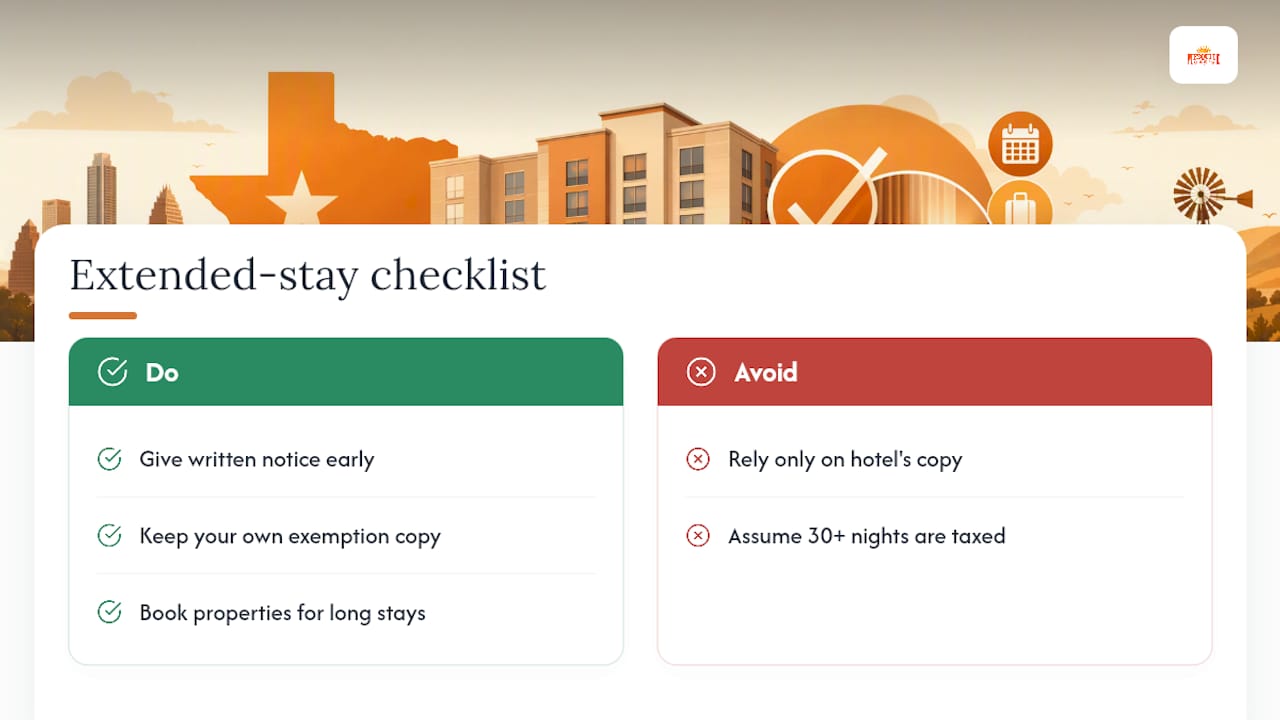
Long-stay properties see the permanent resident rule constantly, since crews and contractors routinely book 30 days or more. Guests planning that kind of stay should give written notice early and keep a copy of any exemption paperwork for their own records, not just the hotel's. Mesquiteoasis structures its online booking and registration around exactly this kind of extended stay, with full-hookup RV sites and furnished lodge rooms built for workers on long assignments in the Permian Basin.
A practical checklist before you check in
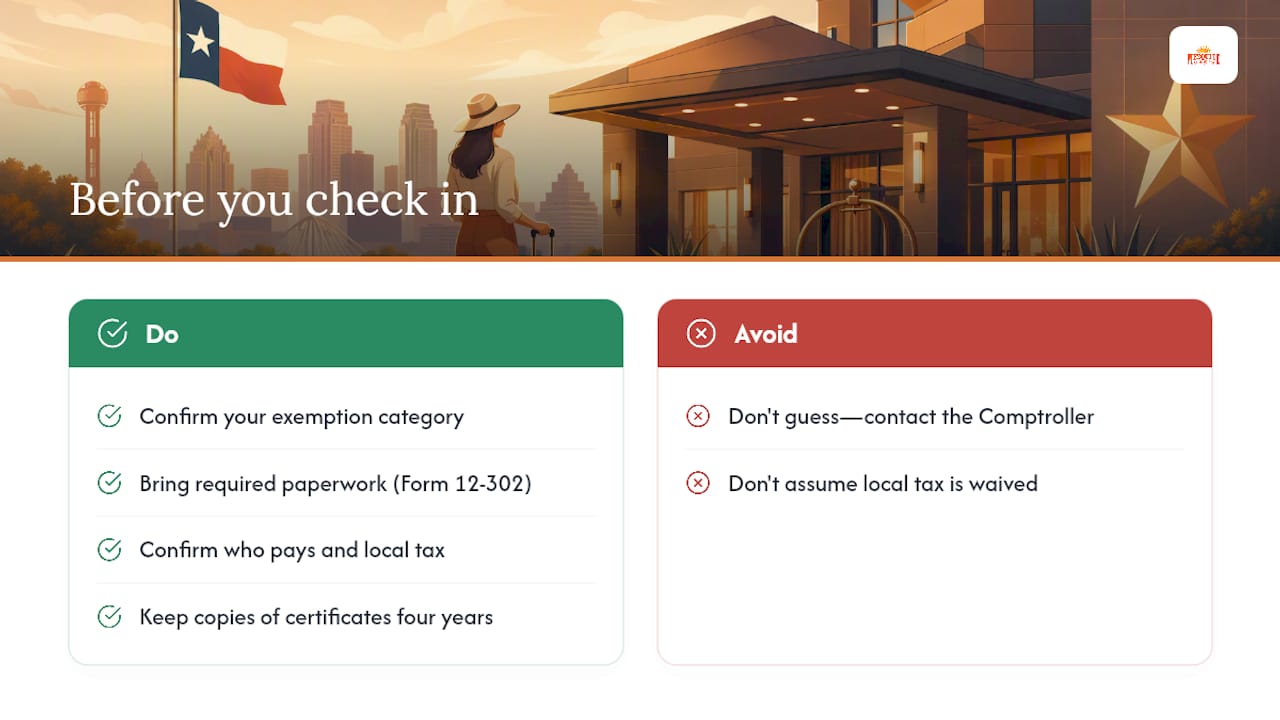
Three things settle nearly every exemption question before it becomes a problem at the front desk. First, confirm which category actually applies to you, government employee, diplomat, nonprofit representative, or permanent resident, because each has slightly different proof requirements. Second, bring the paperwork: a signed Form 12‑302 for most categories, or written notice of an extended stay for permanent residency. Third, confirm who's paying and whether local tax still applies, since that's where exempt guests most often get an unexpected line item on their final bill.
When a situation doesn't fit neatly into any of these categories, contacting the Comptroller's office directly beats guessing. And whichever side of the counter you're on, guest or hotel staff, keeping copies of every exemption certificate for at least four years will save someone a headache down the road.
— Karen
Ready to book an extended stay built around exactly these rules? Mesquite Oasis Lodge & RV Park in Odessa offers full-hookup RV sites and furnished lodge rooms designed for long assignments in the Permian Basin, with an online application and payment process available anytime, no phone calls required.