
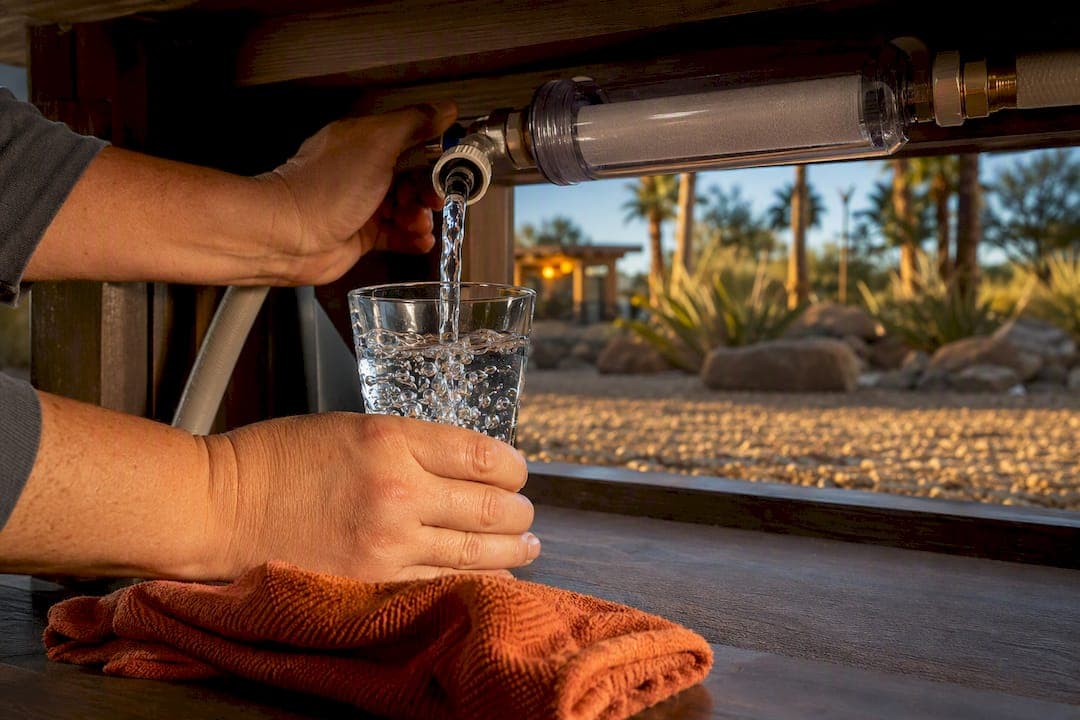
Park water is legally required to be potable, but that label is a floor, not a promise. The single move that protects you: hook up with a food-grade hose and an NSF-certified inline filter every time, and sanitize your fresh tank on a schedule if you're staying long-term. Here's why that matters and what to actually do about it.
TL;DR:
- Potable water standards only guarantee minimum safety at the source; older infrastructure and surface water influence can still cause contamination.
- A standard inline sediment filter cannot remove bacteria or viruses, which require more advanced filtration or UV disinfection, especially if microbial contamination is suspected.
- Long-term residents should layer filters, including a sediment pre-filter, at least one point-of-use filter, and possibly reverse osmosis for well water.
- Regularly sanitize your tank, replace filters based on usage and water conditions, and request water quality tests if problems arise beyond simple filter replacement.
Table of Contents
- What "Potable" Really Means for RV Water Filtration
- Common Contaminants RV Guests Actually Encounter
- Your Arrival Checklist for Filtering RV Water at Any Park
- Building a Long-Term RV Water Treatment Routine
- When to Ask the Park for Water Testing or Report a Problem
- What Long-Stay Guests Get Wrong About Water Safety
- A Place Built for Long Stays, Water Included
- Sources
What "Potable" Really Means for RV Water Filtration
"Potable" is a regulatory pass grade, not a quality certificate. It tells you the water met minimum federal or state health standards at the point it was tested, usually at the wellhead or the municipal main, not necessarily by the time it reaches your rig's hose bib.
RV parks fall under a specific EPA category called transient non-community (TNC) water systems, a classification that covers any public water system serving transient populations like campgrounds, RV parks, and rest stops. TNC status comes with real obligations. Parks must test regularly for total coliform bacteria and nitrates, and if the water source is influenced by surface water rather than a protected groundwater well, the park has to run filtration and disinfection with ongoing monitoring, not just a one-time test.
Where the water actually comes from changes the risk profile:
- Municipal treated supply: Chlorinated and monitored continuously by a city utility, then handed off to the park's internal plumbing.
- Private well: Tested less frequently, often just meeting TNC minimums, and more exposed to local groundwater contamination like agricultural runoff or aging casings.
- Blended or seasonal sources: Some parks switch suppliers by season, which can mean inconsistent treatment history.
The gap between "meets the legal standard" and "tastes and looks clean when it hits your kitchen faucet" is where most problems live. Older park infrastructure with decades-old distribution lines can introduce sediment, discoloration, and biofilm regrowth well after the water passed its official test. Nearby construction or a burst main a mile away can stir up a line without anyone updating you.
Common Contaminants RV Guests Actually Encounter
Not every risk is the same, and not every risk needs the same fix. Splitting contaminants into categories helps you figure out what gear actually solves your problem.
Biological contaminants — total coliform and E. coli — show up when there's a break in the treatment barrier: a cracked line, a backflow event, or a well casing that let surface water intrude. These are the ones TNC testing specifically watches for, because they signal a system failure, not just aesthetic annoyance.
Chemical and aesthetic issues cover chlorine taste, dissolved metals from old pipe, and increasingly PFAS, the "forever chemicals" now showing up in water systems nationwide as monitoring improves. Sediment doesn't make you sick, but it chews through appliance seals, water heater elements, and faucet aerators over months of full-time RV living.
Quick reference: what a standard filter can and can't stop A typical inline sediment filter is rated around 20 microns, fine for rust flakes and grit, but it does nothing against bacteria or viruses. To stop microbial contamination, you need a filter rated closer to 0.2 microns or a UV disinfection unit.
Here's the practical breakdown:
- Sediment and rust: Handled by a basic inline filter, no lab test needed.
- Chlorine taste and odor: Activated carbon filters solve this in seconds.
- Coliforms or E. coli: Requires a certified lab test to confirm, then disinfection or UV, not just filtration.
- Nitrates and heavy metals: Need lab testing and often reverse osmosis, since standard carbon filters barely touch them.
- PFAS: Only certain NSF-rated carbon or RO systems address this; check the filter's specific certification before assuming it works.
Your Arrival Checklist for Filtering RV Water at Any Park
Do this before you fill a single tank. It takes less time than backing into your site.
- Connect a food-grade fresh-water hose only. Never use a garden hose. Standard garden hoses leach chemicals and harbor bacteria that potable-rated hoses are designed to resist.
- Thread on an NSF-certified inline filter at the spigot before the hose ever touches your intake. This is your cheapest insurance against sediment and chlorine, whether you're staying one night or six months.
- Add a pressure regulator ahead of the filter. Park pressure swings can blow out fittings and stress the filter housing.
- Run the first thirty seconds of flow onto the ground, watching for color, cloudiness, or a sulfur smell before it ever enters your tank.
- Note the park's water contact or office location in case you spot a problem later. You'll want that number handy, not buried in a welcome packet.
Pro Tip: Keep a spare filter cartridge in your rig at all times. Swapping a clogged filter takes two minutes; driving to a hardware store because yours failed on a Sunday does not.
Building a Long-Term RV Water Treatment Routine
Weekend campers can get away with a single inline filter. If you're parked for weeks or months, shift-working a Permian Basin site or running a crew rotation, your water passes through the same lines day after day, and small problems compound.
The setup most experienced long-term residents land on is layered, not single-stage:
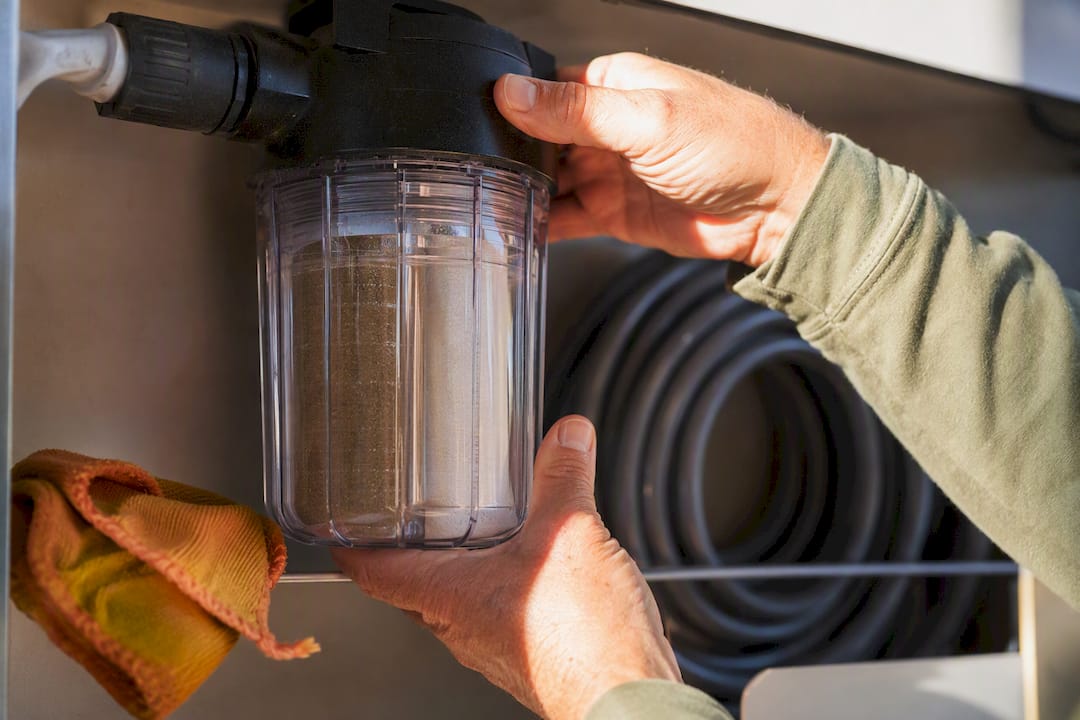
- Sediment pre-filter at the inlet. This is your whole-rig protector, catching grit and rust before it reaches your pump, water heater, and fixtures. It wears out faster than a point-of-use filter because it's doing the heavy lifting for everything downstream.
- Point-of-use filter for drinking and cooking. Installed under the sink or at a dedicated tap, this stage gets you drinking-grade water without the cost and waste of filtering every gallon that goes toward showers and dish rinsing.
- Reverse osmosis, if you're on a well regularly. RO strips nearly everything, including nitrates and dissolved metals that carbon alone misses. The trade-off: it wastes 2 to 5 gallons for every gallon it produces and needs a pressurized storage tank, so it only makes sense if you're budgeting your water use accordingly.
On the maintenance side, sanitize your fresh tank at least twice a year, and more often if you notice a change in taste or smell. Replace filter cartridges on a schedule tied to actual usage and how cloudy your source water tends to run, not just a calendar reminder. A cartridge lasting six months at one park might clog in six weeks at another with heavier sediment.
Build a habit of quick sensory checks: taste and smell weekly, a glance at your inlet filter's color monthly. A filter that suddenly looks brown or gray after weeks of staying clear usually means something changed upstream, often construction or a disturbed line nearby, and it's worth flagging before you keep drinking straight from the tap.
When to Ask the Park for Water Testing or Report a Problem
If something seems off, past the point where a filter swap fixes it, request specifics rather than a vague reassurance. Ask for the park's most recent results on:
- Total coliform and E. coli
- Nitrates and nitrites
- Turbidity readings
- Chlorine residual at the point of entry
Ask when the last test ran and how soon you can see the report. Most TNC systems keep this on file since they're required to test regularly.
Two numbers matter most if you want to know when to stop drinking the water and switch to bottled: a chlorine residual below 0.2 mg/L at the point of entry, or any positive coliform detection. Either one should trigger a boil advisory mindset even if the park hasn't issued one yet.
In the interim, switch to bottled water for drinking, boil water if you must use the tap, and document dates, symptoms if any, and what the water looked or smelled like. A written record helps park management act faster and gives you something concrete if the issue drags on.
What Long-Stay Guests Get Wrong About Water Safety
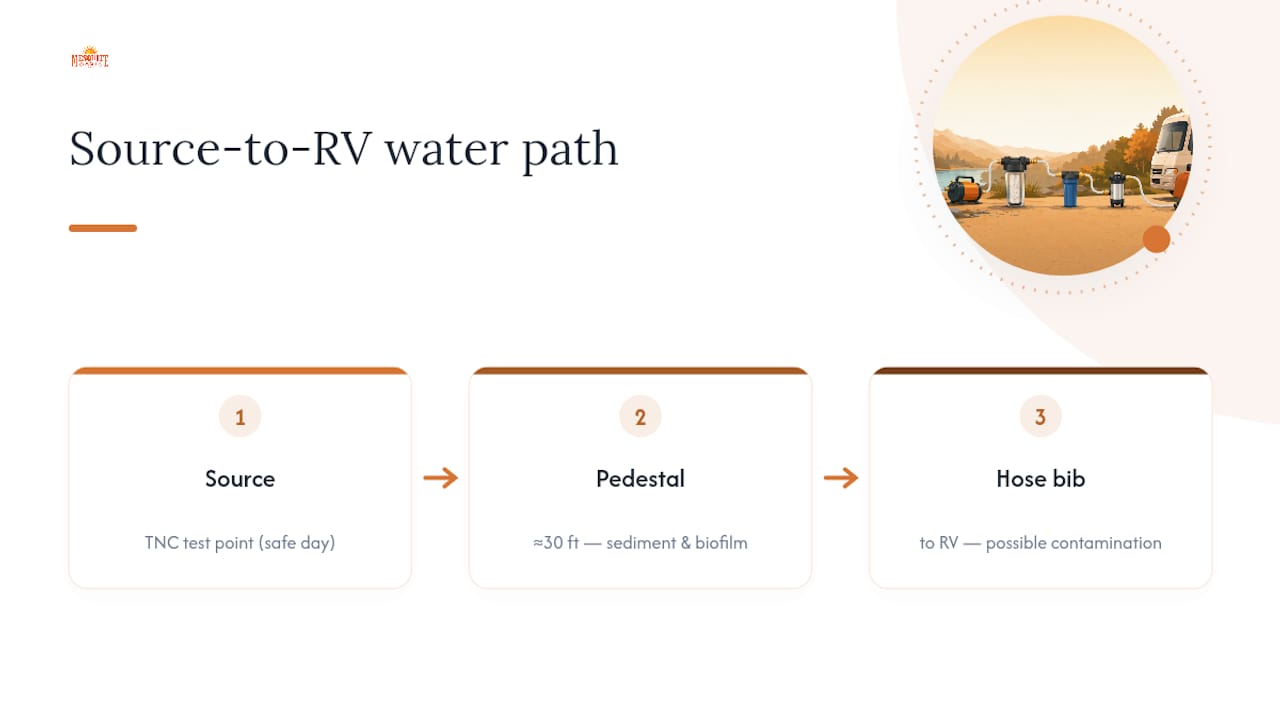
Most guests either over-trust the "potable" sticker or over-engineer their setup with gear they don't need. Neither instinct serves you well. A TNC water system passing its coliform and nitrate tests tells you the source was safe on test day. It says nothing about the thirty feet of pedestal plumbing between the spigot and your hose, which is exactly where sediment and biofilm tend to build up in older infrastructure.
RO makes sense if you're on a well long-term. It's overkill, and a water-waste headache, for someone on treated municipal supply for a six-week assignment.
What I'd tell any shift worker or contractor settling into a long stay: spend the twenty dollars on an inline filter before you spend anything on RO gear, watch how your water behaves for the first two weeks, and adjust from there. The pedestal you connect to matters as much as the filter you buy. A well-maintained hookup with clean, recently-tested lines beats a fancy filtration stack fighting bad plumbing every time.
— Karen
A Place Built for Long Stays, Water Included
Filtration gear only solves half the equation. The other half is choosing a park that maintains its plumbing and treats water quality as part of the deal, not an afterthought. Mesquite Oasis Lodge & RV Park runs 241 full-hookup RV sites and 110 furnished lodge rooms in Odessa, with utilities included and no guessing about what you're paying for month to month.
Guests handle applications, payments, and account access entirely online, no phone calls, no waiting on hold to sort out a billing question during a night shift. For crews and contractors settling in for weeks or months at a time, that kind of predictable setup matters as much as any filter cartridge. Check current availability and reserve your site online whenever your schedule allows, day or night.
This article is general information, not a substitute for advice from a qualified doctor. Consult a qualified healthcare professional about your own circumstances before acting on anything here.
Sources
- EPA: Surface Water Treatment and monitoring requirements (excerpt)
- How to Drink Campground Water Safely — Kohree
- RV Water Filter System: Which Type Do You Actually Need? — PalmGear