
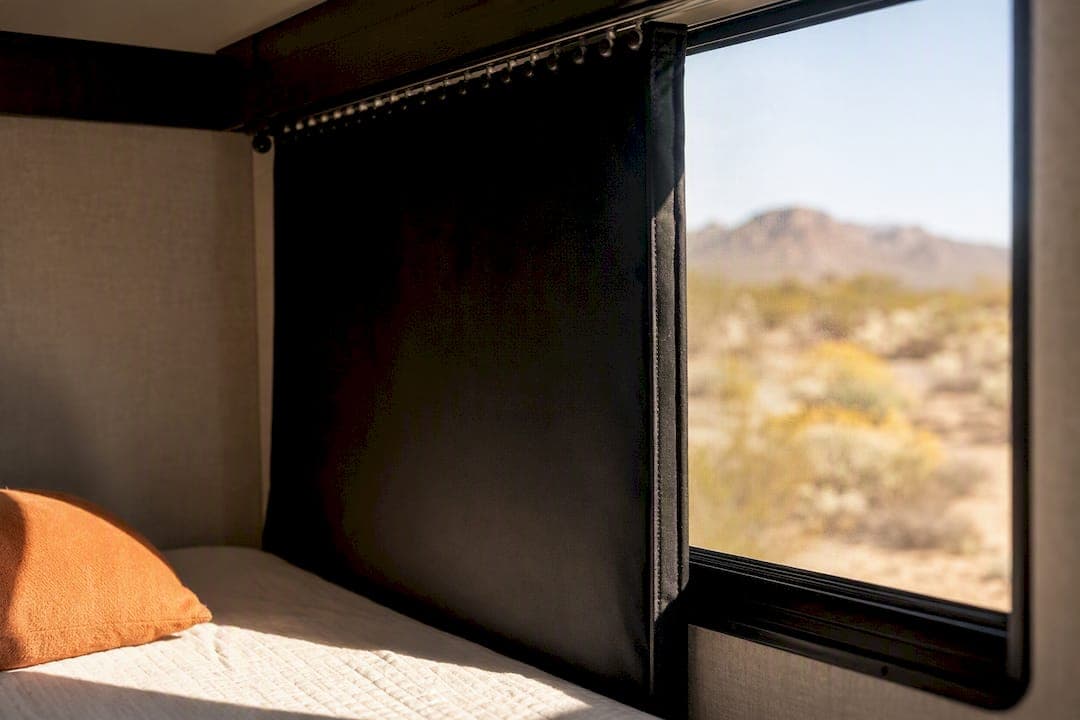
For most RVers, the right pick comes down to three types: portable suction-mounted panels for renters who need fast, damage-free setup, custom roller or cellular shades for full-timers who want a permanent and neat install, and bonded-liner curtain panels for anyone chasing true blackout on a budget. Whatever you choose, edge sealing decides whether you actually get cave-dark darkness or just a dimmer room.
TL;DR:
- Portable suction-mounted panels are the fastest and most reliable blackout solution for renters or travelers who want no-drill installation and easy packing.
- Custom roller or cellular shades offer the best durability and precise fit for full-time RVers, with hardware designed for long-term use and better edge sealing.
- Edge sealing techniques, such as mounting hardware beyond the window frame and using side channels or wraparound rods, are critical for achieving true darkness.
- Not all "blackout" fabrics block light equally; triple-weave fabrics typically block 85-99% of light, but sealing gaps with hardware is essential for complete darkness.
- Layering window tint with blackout curtains or panels provides superior heat reduction and full-dark control, especially in variable climates or for those who need both benefits.
Table of Contents
- What Are the Best RV Blackout Curtain Options?
- How Do You Choose the Right Blackout Solution for Your RV?
- How Do You Install Blackout Curtains Without Drilling?
- What Installation Details Actually Produce True Darkness?
- What Do "Blackout" Fabric Claims Actually Mean?
- Where Can You Buy RV Blackout Curtains, and What Do They Cost?
- How Do You Maintain and Clean RV Blackout Curtains?
- How Do Blackout Curtains Compare to Tinted Windows and Standard Curtains?
- What Customization Options Exist for RV Blackout Curtains?
- How Do Blackout Curtains Affect RV Privacy and Security?
- What Warranty and Return Policies Should You Expect?
- A Straight Answer on What Actually Works
- Mesquite Oasis: A Restful Home Base Between Upgrades
- Vendor Pages Worth Checking Before You Buy
- Sources
What Are the Best RV Blackout Curtain Options?
Roller shades, cellular shades, direct-apply panels, and curtain panels all claim "blackout," but they don't deliver the same result. The differences show up mostly in how light-blocking is achieved and how much control you have over edge gaps.
Roller and cellular shades from a specialist like RVBlinds mount into a cassette or headrail, so the fabric tracks in a channel and there's less room for light to sneak in around the sides. RVBlinds' blackout shade lineup fits common RV window widths from 14 to 62 inches and heights from 24 to 60 inches, with custom sizing for oddball openings. Direct-apply panels, like the Sleepout Portable Blackout Curtain 3.0 XL, skip hardware entirely and press flush against the glass using locking suction cups, which sidesteps the gap problem instead of trying to manage it. Off-the-shelf curtain panels sold on Amazon are the cheapest route, but quality varies a lot from one listing to the next.
| Type | Light-blocking | Best for | Installation | Price range | Thermal performance |
|---|---|---|---|---|---|
| Roller/cassette shades | 100% blackout fabric option | Full-time RVers wanting a permanent install | Headrail mount, screws | Mid to high | Strong, especially with exterior versions |
| Cellular/honeycomb shades | 100% blackout fabric option | Travelers who also want insulation | Headrail mount, screws | Mid to high | Best of the group, traps air in cells |
| Direct-apply suction/Velcro panels | Certified 100% blackout | Renters, shift workers, fast setup | Suction cups or adhesive Velcro, no drilling | Low to mid | Moderate, depends on backing |
| Bonded-liner curtain panels | Near 100% with proper liner | Budget buyers wanting real darkness | Wraparound or tension rod | Low to mid | Moderate |
A day sleeper working nights should lean toward direct-apply panels or bonded-liner curtains with a wraparound rod, since both attack the edge-gap problem directly. A full-timer parked in the same spot for months gets more value from a cassette shade that looks finished and won't sag over time. Someone who only camps a few weekends a year might be fine with an inexpensive Amazon panel, as long as it's paired with decent hardware.
How Do You Choose the Right Blackout Solution for Your RV?
Matching the product to how you actually use your rig matters more than chasing the highest blackout percentage on a label.
- Day sleepers and shift workers should prioritize sealed 100% blackout panels or bonded-liner curtains over standard room-darkening fabric. Even a sliver of midday light at the edges can disrupt sleep, since experts note that light leakage often does more damage than fabric choice.
- Full-time RVers get the most mileage from custom roller or cellular shades. They're not going anywhere, so the upfront cost of a cassette install pays off in a tidier cabin and better long-term durability.
- Renters and short-term travelers should default to portable suction panels. No drilling, no measuring for a rod, and you can pack them up and reuse them at the next stop.
Before you order anything, measure the glass itself, not the window frame, and add enough oversize allowance so your panel or shade can seal past the edges. Inside-mount shades need exact glass dimensions; outside-mount curtains need extra width and height to cover the trim.
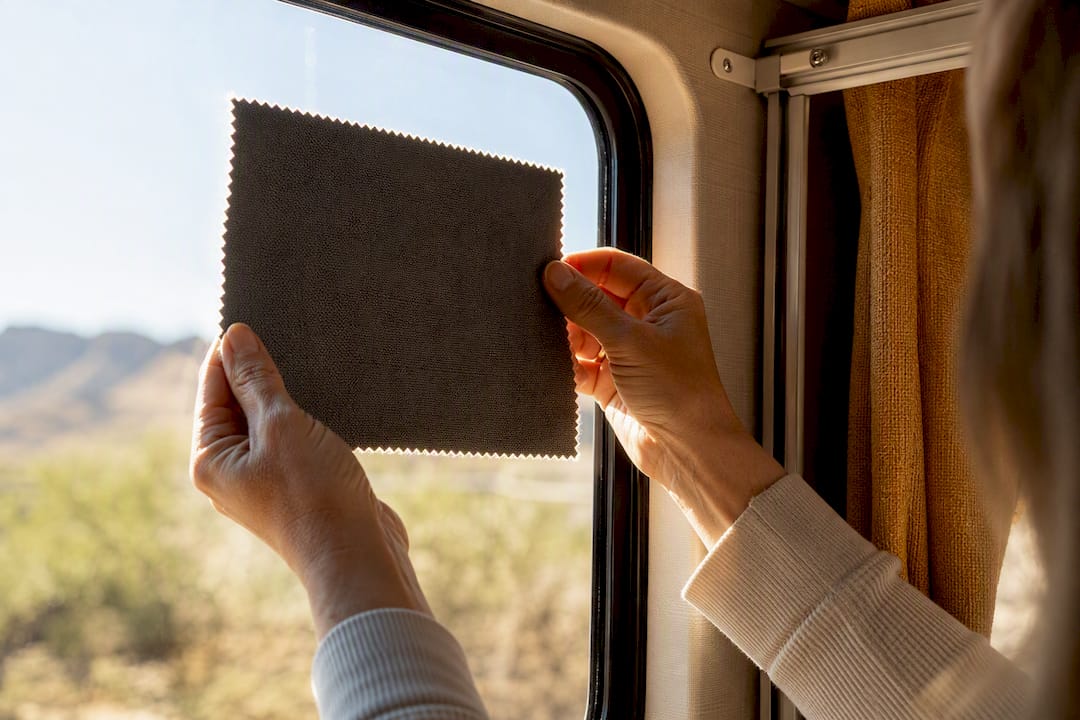
Pro Tip: Order a fabric sample before committing to a full custom shade. A swatch held up against your window at noon tells you more about actual light-blocking than any percentage on the product page.
How Do You Install Blackout Curtains Without Drilling?
You don't need a drill to get a real blackout result. Two no-drill methods cover most RV setups.
- Measure your glass, then buy a panel sized 2 to 4 inches larger on every side.
- Press a suction or Velcro-mounted panel, such as the Sleepout Portable Blackout Curtain, flush against the glass, starting from one corner and working outward to avoid trapped air bubbles.
- Add extra suction points at the corners, where light gaps are most likely to form.
- If you still see a faint glow at the center, close any factory-installed blind underneath before mounting the panel over it.
For RVs where drilling is allowed, a no-sew bonded-liner curtain on a wraparound tension rod is nearly as fast. Just slide the rod through existing curtain pockets or clip-on rings, then extend it so the curtain wraps slightly around the window frame instead of hanging flat.
- Combine an exterior shade with an interior blackout panel for the biggest heat reduction, since blocking sun before it hits the glass beats blocking it after.
- Keep a spare suction cup or two on hand. They wear out faster than the fabric does.
What Installation Details Actually Produce True Darkness?
The fabric gets most of the attention, but hardware decides whether a "blackout" curtain actually blocks light.
- Mount rods or headrails 4 to 6 inches beyond the window frame on each side when your wall space allows it, since this gives the fabric room to overlap the frame instead of stopping right at the glass edge.
- Use wraparound rods, side channels, adhesive Velcro strips, or flush suction mounts. These four methods consistently outperform a flat panel hung straight in front of a window.
- Choose solid 1-inch rods with center supports for heavier bonded-liner curtains, since thin rods sag under the weight and create a bow that lets light leak through the middle.
- Add hold-down clips or a weighted bottom rail on panels that hang near vents or doors, so highway vibration doesn't work the fabric loose from its seal.
Pro Tip: If your curtain has an operating cord, check that it meets federal cordless or secured-cord safety standards before installing it anywhere near kids or pets in the RV.
What Do "Blackout" Fabric Claims Actually Mean?
Not all "blackout" labels mean the same thing, and the fabric construction underneath the marketing term is what actually matters.
Triple-weave fabrics, often sold as "room-darkening," typically block 85% to 99% of light according to independent testing. That last percentage sounds close to complete, but at noon it can still leave a room noticeably lit.
Cellular or honeycomb shades add another benefit beyond opacity: their accordion-style cells trap a layer of air, which raises insulating value and slows heat transfer through the window compared with a flat panel. Exterior shades push this further. RVBlinds reports its exterior blackout shades block a very high percentage of sunlight before it ever reaches the glass, which keeps the cabin cooler than any interior-only solution can manage on its own.
Where Can You Buy RV Blackout Curtains, and What Do They Cost?
Three retail paths cover almost every RV blackout purchase.
- Amazon carries off-the-shelf panels sized for RV windows, often in the 42 by 36 inch range, at the lowest price point but with inconsistent blackout performance between listings.
- RVBlinds sells RV-specific custom roller, cellular, and cassette shades built to exact window dimensions, priced higher but built for years of daily use.
- Sleepout sells portable, certified blackout panels for renters and travelers who want a fast setup with no hardware.
Portable suction panels sit in the low to mid price band, off-the-shelf bonded-liner curtains land in a similar low to mid range, and custom roller or cellular shades run mid to high. Before ordering, request a fabric sample, verify the seller's fit or return policy, and confirm the hardware is rated for travel use rather than stationary home installs.
How Do You Maintain and Clean RV Blackout Curtains?
Most blackout fabric handles cleaning differently than a regular cotton curtain, mainly because of the bonded backing or cellular structure.
Spot-clean bonded-liner panels with a damp cloth and mild soap rather than tossing them in a washing machine. The backing layer can crack or peel if it's agitated too much or dried on high heat. For fabric that's fully machine-washable, check the product tag first. Many blackout liners specify cold water and a gentle cycle, with air drying only.
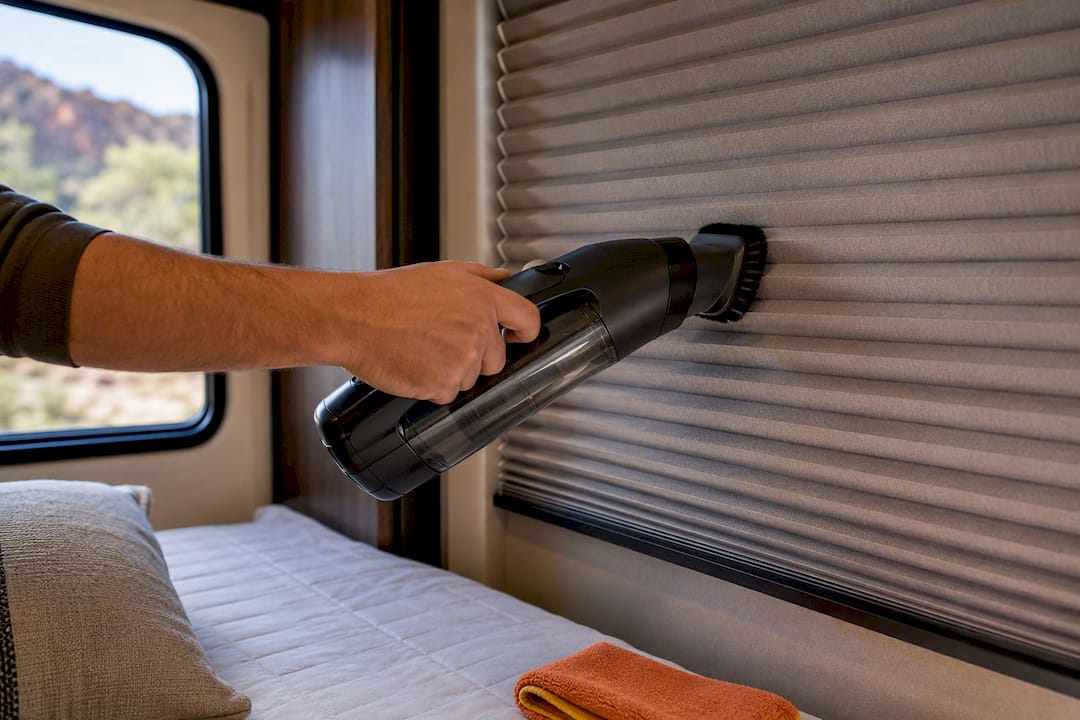
Cellular and honeycomb shades collect dust in the pleats faster than flat panels do. A handheld vacuum with a brush attachment, run along each fold every couple of weeks, keeps them from looking gray over time. Avoid soaking cellular shades since trapped moisture between the cell layers is hard to dry out completely and can lead to mildew, especially in humid climates.
Suction and Velcro panels need the least maintenance, but the mounting points need attention. Wipe suction cups clean of dust and oils periodically so they keep sealing tightly. Replace them once they stop holding without extra pressure, since a weak suction cup is the most common cause of blackout panels sliding down mid-trip.
Check hardware for rust or corrosion if you're parked near the coast or run your AC constantly, since condensation can collect on rods and clips over a season.
How Do Blackout Curtains Compare to Tinted Windows and Standard Curtains?
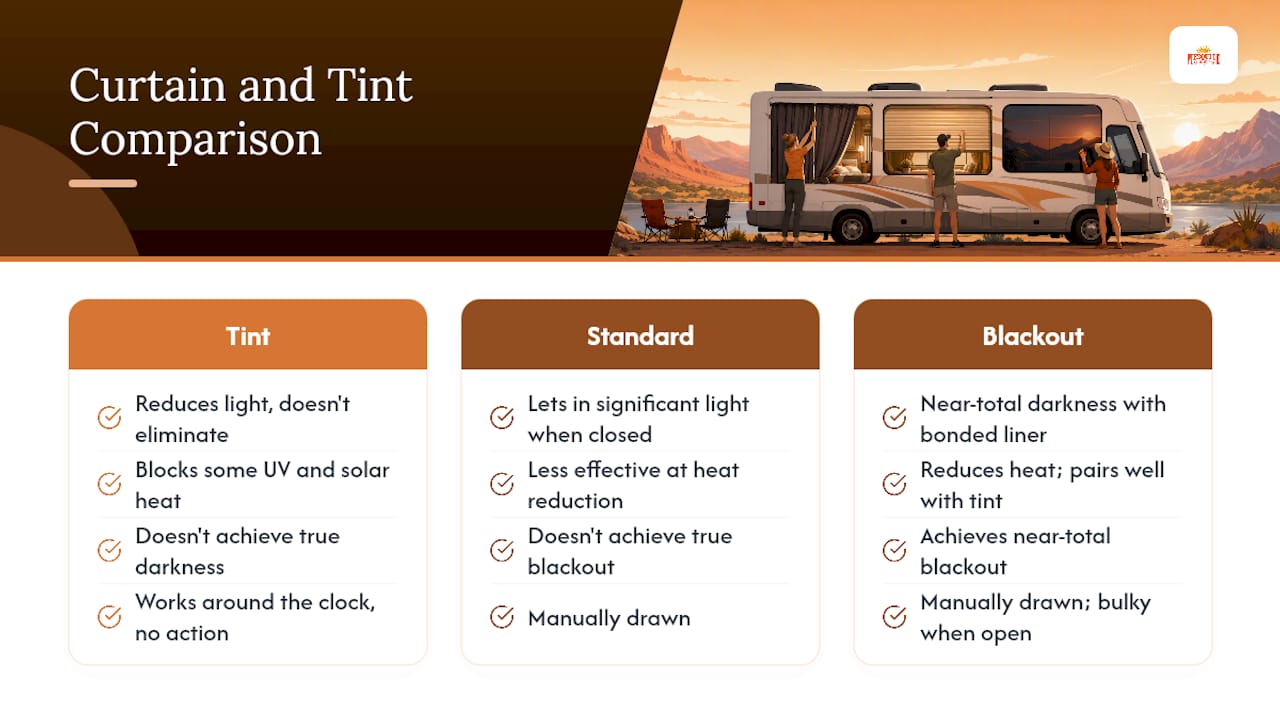
Blackout curtains, tinted windows, and standard curtains all reduce light and heat, but only one of them gets you to true darkness.
Window tint cuts glare and blocks a portion of UV rays and solar heat, and it works around the clock without you having to open or close anything. But tint doesn't eliminate light. Even dark tint still lets in a visible glow during the day, which makes it a poor solo option for a day sleeper who needs the room fully dark.
Standard curtains, the kind sold for houses or generic decor, are built for privacy and style first. Most use a single layer of fabric with no liner, so they let in significant light even when fully closed. They're the least effective option of the three for anyone chasing true blackout.
Purpose-built blackout curtains with a bonded liner are the only option of the three that reliably gets a room to near-total darkness. The trade-off is that they need to be manually drawn, take up more space when open, and cost more upfront than tint or basic curtains. Combining approaches often works best: tinted windows plus a light-blocking curtain layered on top gives you round-the-clock heat reduction and full-dark control when you need it.
What Customization Options Exist for RV Blackout Curtains?
Blackout doesn't have to mean plain and utilitarian. Both custom shade makers and off-the-shelf retailers offer real choice in how the finished product looks.
Custom roller and cellular shades from specialists typically come in a range of neutral fabric tones, from bright white to charcoal, plus some patterned or textured options depending on the product line. Cassette color and headrail finish can often be matched to your RV's interior trim.
Curtain panels give you the widest range of customization since they're sold by dozens of manufacturers. You'll find solid colors, prints, and varying fabric weights, from lightweight cotton blends with a bonded liner to heavier velvet-style options. The trade-off is that heavier decorative fabric adds weight, which means you'll need sturdier rod hardware to prevent sagging.
Portable suction panels are the most limited in style since the priority is function over form, but manufacturers increasingly offer a couple of color choices rather than a single default.
If personalization matters as much as performance, prioritize bonded-liner or cellular products from vendors that publish a full color and pattern catalog, then confirm the exact blackout claim before choosing based on looks alone.
How Do Blackout Curtains Affect RV Privacy and Security?
A fully sealed blackout curtain does double duty: it blocks light and it blocks anyone outside from seeing in.
Standard curtains and even most tinted windows still allow some visibility into the RV once interior lights are on at night, especially at close range in a crowded campground. A bonded-liner blackout curtain or a properly sealed cellular shade eliminates that silhouette effect almost entirely, since the same opacity that stops sunlight during the day stops interior light from escaping after dark.
This matters more in RV parks than most people realize. Sites are often close together, and a lit window with a visible silhouette signals exactly where you are and what you're doing. Full blackout coverage, especially on panels with sealed edges, removes that visual cue.
Security benefits follow the same logic. A window that can't be seen through gives a potential intruder less information about whether you're home, what's inside, or when you're asleep. It's not a substitute for locks or an alarm system, but it removes an easy way to scout a rig from outside.
The one caveat: portable suction panels that don't fully seal at the edges can leave a visible sliver at the frame, which undercuts both the privacy and security benefit. The same edge-sealing techniques that create true blackout also close that visibility gap, so getting the seal right serves two purposes at once.
What Warranty and Return Policies Should You Expect?
Warranty coverage on RV blackout curtains varies more than most buyers expect, and the return window often matters more than the warranty length.
Custom shade makers like RVBlinds typically back their hardware and fabric against defects for a set period after purchase, though exact terms depend on the product line and should be confirmed directly on the vendor's page before ordering. Because these are made-to-measure, return policies are usually stricter. Incorrect measurements are on the buyer, which is why a measurement guide and, ideally, a sample swatch matter before you commit to a custom order.
Portable panel makers like Sleepout tend to offer more standard retail-style return windows since their products are pre-sized rather than custom-built, making a straightforward exchange or refund easier if the fit or fabric isn't right.
Off-the-shelf listings on Amazon carry the marketplace's standard return policy in most cases, which is often the most forgiving of the three, but individual sellers can set their own conditions on damaged or used items. Always check the specific listing rather than assuming a blanket policy applies.
Before buying anywhere, read the return policy for how it handles cut-to-size or custom-colored items, since these are frequently final-sale. A vendor willing to send a physical fabric sample before you order is usually a sign they stand behind the fit and finish of what they sell.
A Straight Answer on What Actually Works
Portable sealed panels are the fastest, most reliable way to get real blackout if you're renting, moving often, or just tired of fighting with curtain rods. Custom shades earn their higher price if you're living in your rig full-time. Either way, budget for gap-control hardware alongside the fabric. A great liner mounted with a cheap tension rod still lets light through.
— Karen
Mesquite Oasis: A Restful Home Base Between Upgrades
Even the best-sealed blackout curtain can't fix a noisy, cramped, or unsecured parking spot — consider how to book a weekend stay and get the best deal for more restful travel. If you're passing through the Permian Basin and want a site built around actual rest, Mesquite Oasis Lodge & RV Park in Odessa, Texas offers 241 full-hookup RV sites and 110 furnished lodge rooms with the kind of quiet, gated setup that makes your blackout curtains do less work in the first place.

Every stay includes access to laundry facilities, a gym, and community spaces through a personal PIN code, and the entire booking process runs online, from application to payment, with no phone calls required. That matters if you're working shifts in the Basin and need to lock in housing on your own schedule rather than during business hours. Check current availability and reserve a full-hookup RV site directly through the online application system whenever it fits your day.
Vendor Pages Worth Checking Before You Buy
For specs, sizing, and certifications, start with RVBlinds' blackout shade catalog and the Sleepout portable panel page. Confirm sample and fit-guarantee policies before ordering either.
Sources
- RVBlackout Shades | RVBlinds
- Best blackout curtains for day sleepers · SleepyHero
- Safety standard for operating cords on custom window coverings — Federal Register