
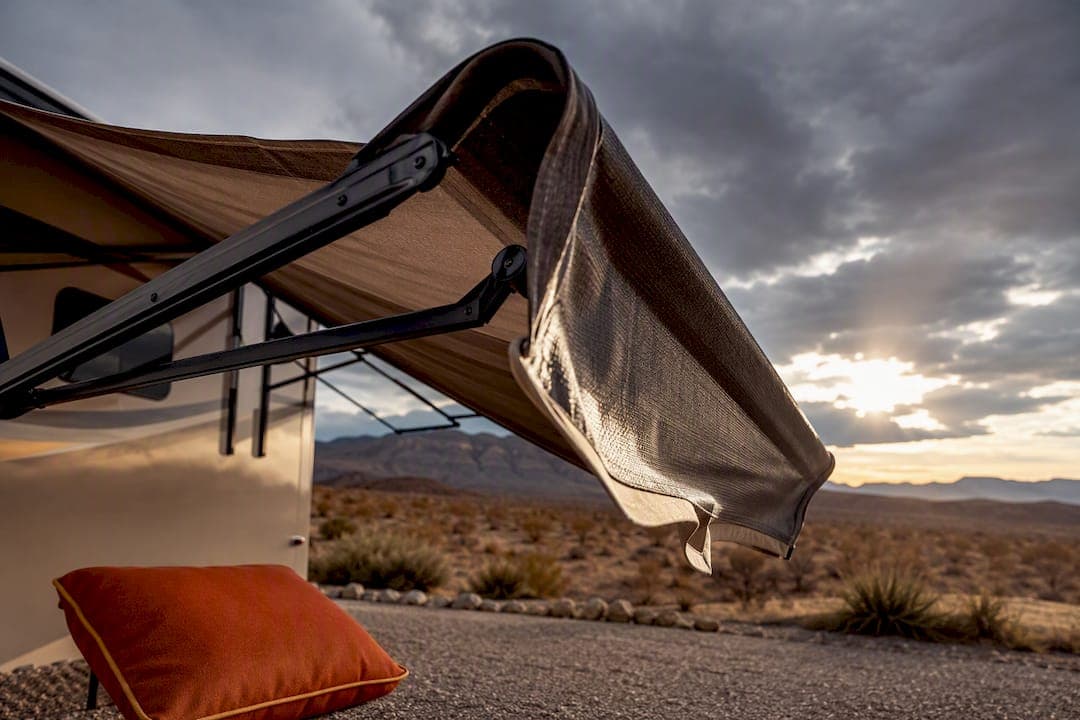
Retract your RV awning once sustained wind hits the 15 to 20 mph caution band, and go earlier if gusts are climbing or you're leaving the site unattended, especially to protect your awning. Automatic wind sensors help by retracting awnings during strong winds, but they react to current conditions rather than forecasting gusts ahead. When in doubt, roll it in. A torn awning is an inconvenience; a bent arm through your sidewall is a repair bill.
TL;DR:
- Awnings should be retracted at 15 to 20 mph wind speed, especially on wider models, to prevent structural damage or safety hazards.
- Using a handheld anemometer and observing flags or nearby trees provides more accurate wind risk assessments than general weather forecasts.
- Wind sensors and proper hardware, like tilt and de-flappers, help mitigate damage but cannot replace proactive owner judgment to retract early.
- Wind-induced damage, often resulting in fabric tears or bent support arms, can reach repair costs into the thousands, with warranties typically excluding such damage.
- Always retract awnings before night or when storm conditions are imminent, as waiting for fabric sway or sensor alerts often comes too late to prevent damage.
Table of Contents
- RV Awning Wind Speed Thresholds You Can Actually Use
- How to Judge Wind Risk Before You Ever Extend the Awning
- Wind Sensors, Tie-Downs, and Tilting: What Actually Protects Your Awning
- What to Do the Moment Wind Picks Up
- The Damage Wind Actually Causes, and What It Costs to Fix
- An RV Park Host's View on Awning Safety
- Why "Just Watch the Sky" Isn't Good Enough Anymore
- A Prepared Place to Park When Weather Turns
- Where These Numbers Come From
- Sources
RV Awning Wind Speed Thresholds You Can Actually Use
Wind doesn't announce itself in neat categories, but RV owners need something more useful than "watch the sky." Here's the band system that specialists actually recommend:
- Under 10 mph — Light air. Fine to leave extended, but check it periodically if you're not right there.
- 10 to 15 mph — Caution zone. You'll see visible sway in the fabric. If you're heading inside for a while or it's getting dark, consider closing the awning as a precaution.
- 15 to 20 mph — Risk territory. Retract, full stop, especially on awnings 12 feet or wider. Bigger fabric catches more wind, the same way a bigger sail moves a bigger boat.
- 25 mph and up, or an approaching storm cell — Danger. Strong wind gusts or approaching storms require immediately retracting your awning.
Most standard RV awnings simply aren't built to handle sustained wind past roughly 20 mph, and the risk of real structural damage climbs fast once gusts cross 25 mph. Location matters just as much as the number on your phone. An awning in an open field or on a coastal site faces steadier, harder gusts than the same rig tucked between trees or buildings, so treat these thresholds as a starting point, not a guarantee, and adjust down if your site is exposed.
How to Judge Wind Risk Before You Ever Extend the Awning
A phone forecast tells you what's happening ten miles away at an airport, not what's hitting your specific campsite right now. Close that gap with a few fast checks:
- Use a handheld anemometer or a smartphone wind app. These give you an actual number instead of a guess, and they're the most reliable tool most owners will ever carry.
- Read the Beaufort scale in real time. Leaves rustling and small branches swaying translates to roughly 8 to 12 mph; whole trees swaying and loose objects moving means you're already well past caution.
- Watch flags, not your awning fabric. A flag standing straight out is a faster, earlier signal than fabric sway, which often shows up only after wind is already a problem.
- Factor in your surroundings. Open plains, coastlines, and mountain valleys funnel and amplify wind well beyond what a general area forecast predicts.
Awning sway is a lagging indicator. By the time you can see fabric shuddering, the gust causing it has already arrived, and the next one is often stronger.
Pro Tip: Keep a $15 handheld anemometer clipped inside your tow vehicle. Checking it takes ten seconds and beats guessing based on how the flag at the site office looks from 200 feet away.
Wind Sensors, Tie-Downs, and Tilting: What Actually Protects Your Awning
Hardware helps, but each option comes with real trade-offs worth understanding before you buy or install anything, especially considering the role of wind in water sports safety which highlights the importance of wind awareness in outdoor activities.
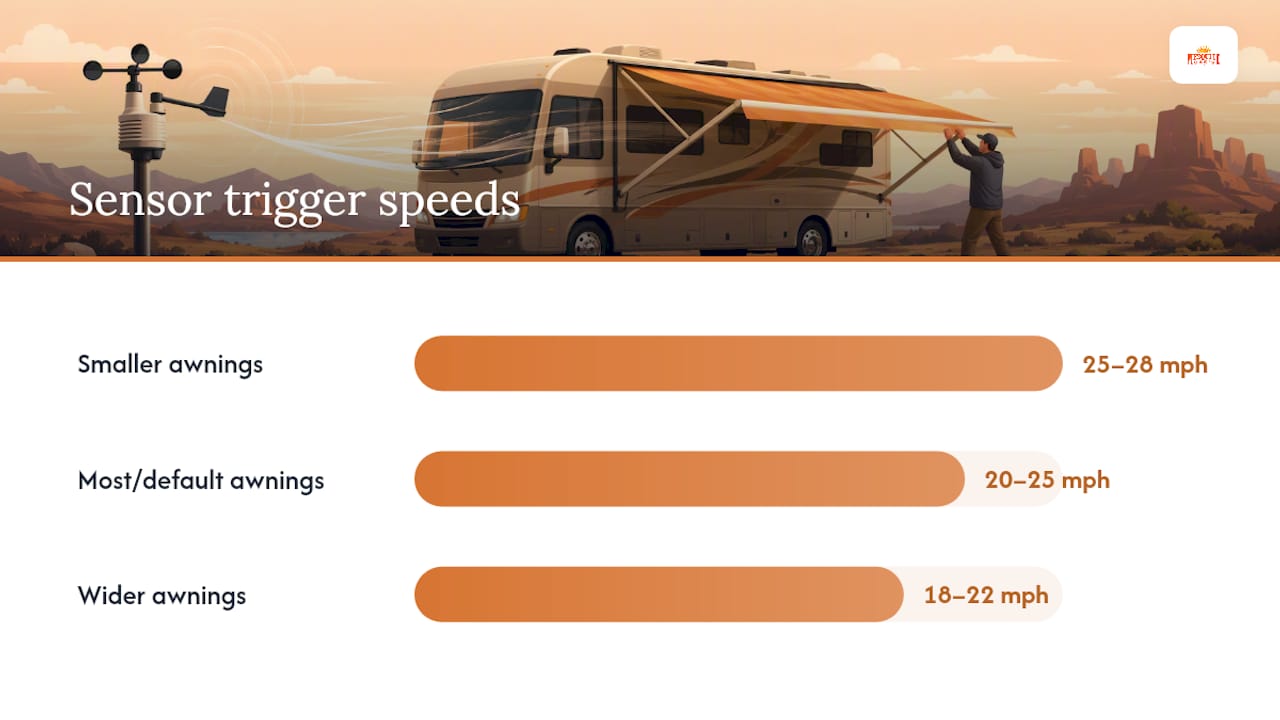
Wind sensors are the most common upgrade. Vibration sensors detect sustained shaking, usually triggering after 6 to 12 seconds of movement and retracting the awning automatically. Anemometer-style and motion sensors watch actual airspeed. Most default to triggering somewhere in the 20 to 25 mph range, but that default isn't one-size-fits-all. Smaller awnings can usually run a higher threshold, around 25 to 28 mph, while wider awnings should be set lower, closer to 18 to 22 mph, since more fabric means more force at the same wind speed.
- Integrated factory sensors, like those built into Dometic or Carefree systems, calibrate threshold and motor speed to that specific awning, which generally makes them more reliable than universal aftermarket units.
- Aftermarket sensors typically run $80 to $200 and work across many 12-volt electric awnings, offering solid ROI even if they're less precisely tuned.
- Tie-downs and stakes sound like common sense, but awnings act like large sails and often aren't anchored to structural studs. Staking one down can create a brand-new load path that yanks on brackets never designed to take that force, sometimes tearing the mounting point out of the sidewall instead of protecting the fabric.
- Tilting one side and installing de-flappers cuts lift and stops rainwater from pooling in the fabric, addressing two failure modes at once with almost no downside.
A sensor costing from tens to a couple hundred dollars is a small investment compared to potential repair bills that can reach thousands.
What to Do the Moment Wind Picks Up
- Clear the area first. Move people, pets, chairs, and anything loose out from under and around the awning before you touch a switch.
- Retract in a controlled way. Motorized awnings should be stowed using the normal switch sequence, not forced or rushed; manual awnings need both arms released evenly so the fabric doesn't twist.
- If it's stuck or tangled, stop. Don't force a jammed arm or motor. Secure loose fabric as best you can, back away from the area, and call a mobile RV tech or your park's maintenance line.
- Check everything once the wind passes. Look over the arms for bending, inspect the fabric for tears, and check mounting brackets for looseness before you extend it again.
Trying to out-muscle a gust while an awning is halfway retracted is how people get hurt. Get ahead of it instead.
The Damage Wind Actually Causes, and What It Costs to Fix
Torn fabric is the most common outcome, but bent support arms, ripped mounting brackets, and cracked sidewall panels show up constantly in wind-damage reports. Fabric replacement alone tends to run a few hundred dollars. Add arm or bracket damage, and repairs can climb into the low thousands once sidewall work is involved.
Here's the part that surprises new owners: most RV warranties exclude wind damage entirely, treating it as owner-preventable rather than a manufacturing defect. That shifts the entire cost onto you.
- Retract early, before the caution band, not after.
- A $60 to $200 sensor is a rounding error next to a $2,000 sidewall repair.
- Inspect hardware regularly. Worn arms and loose mounting points fail at lower wind speeds than new ones.
An RV Park Host's View on Awning Safety
Running Mesquite Oasis in Odessa, Texas puts West Texas wind squarely in our daily operations, not an abstract risk. Some RV parks are located in open, exposed terrain where gusts can build fast and unpredictably.
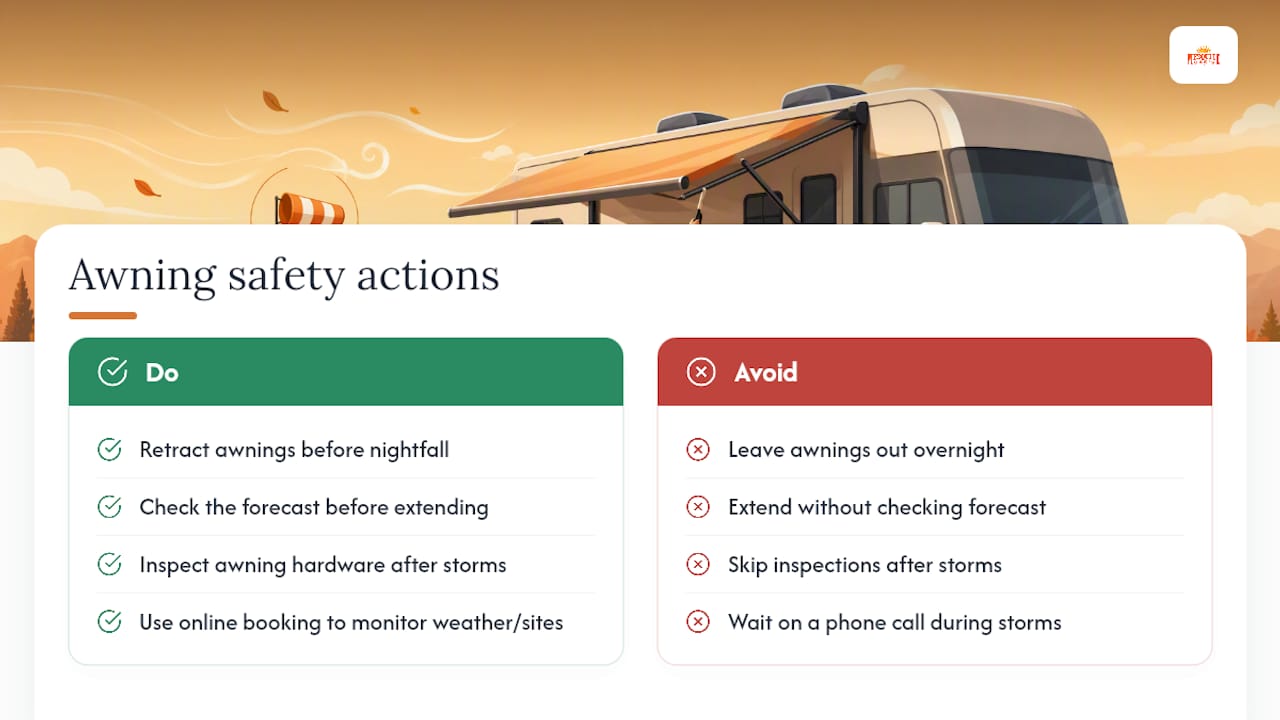
Our advice mirrors what the numbers above already tell you: It is advisable to retract awnings before nightfall every night for safety. Check the forecast before you extend the awning at all, not after you've already set up camp for the evening. Following storms, inspect your awning hardware carefully before extending it again to ensure no damage occurred. Guests managing their stay through our online booking system can check in on weather and site details anytime, without waiting on a phone call during a storm.
Why "Just Watch the Sky" Isn't Good Enough Anymore
Wind safety for awnings benefits from clear, quantitative guidelines rather than subjective judgment. It's a numbers problem with a clear answer, and the RV community's own habits prove it: ask any long-time owner and you'll hear some version of "if it's too windy for a campfire, it's too windy for the awning." That instinct is right, but it undersells how fast conditions shift on exposed sites.
The real gap in conventional advice is timing. Rather than waiting for visible sway or sensor alerts, retracting awnings proactively on a schedule reduces risk. Sensors provide helpful automatic protection but should not replace proactive owner decision-making. A vibration sensor needs several seconds of shaking before it reacts, and by then a gust has already tested your fabric and hardware.
If there's one thing worth prioritizing above sensors, tie-downs, or fancy hardware, it's habit: A best practice is to extend awnings late, retract early, and never leave them out overnight regardless of forecast. That single behavior prevents more damage than any single piece of equipment ever will.
— Karen
A Prepared Place to Park When Weather Turns
West Texas wind doesn't wait for a convenient moment, and neither should your booking process. This RV resort offers online booking and site management services, so you're never stuck waiting on hold with a park office while a storm rolls in.
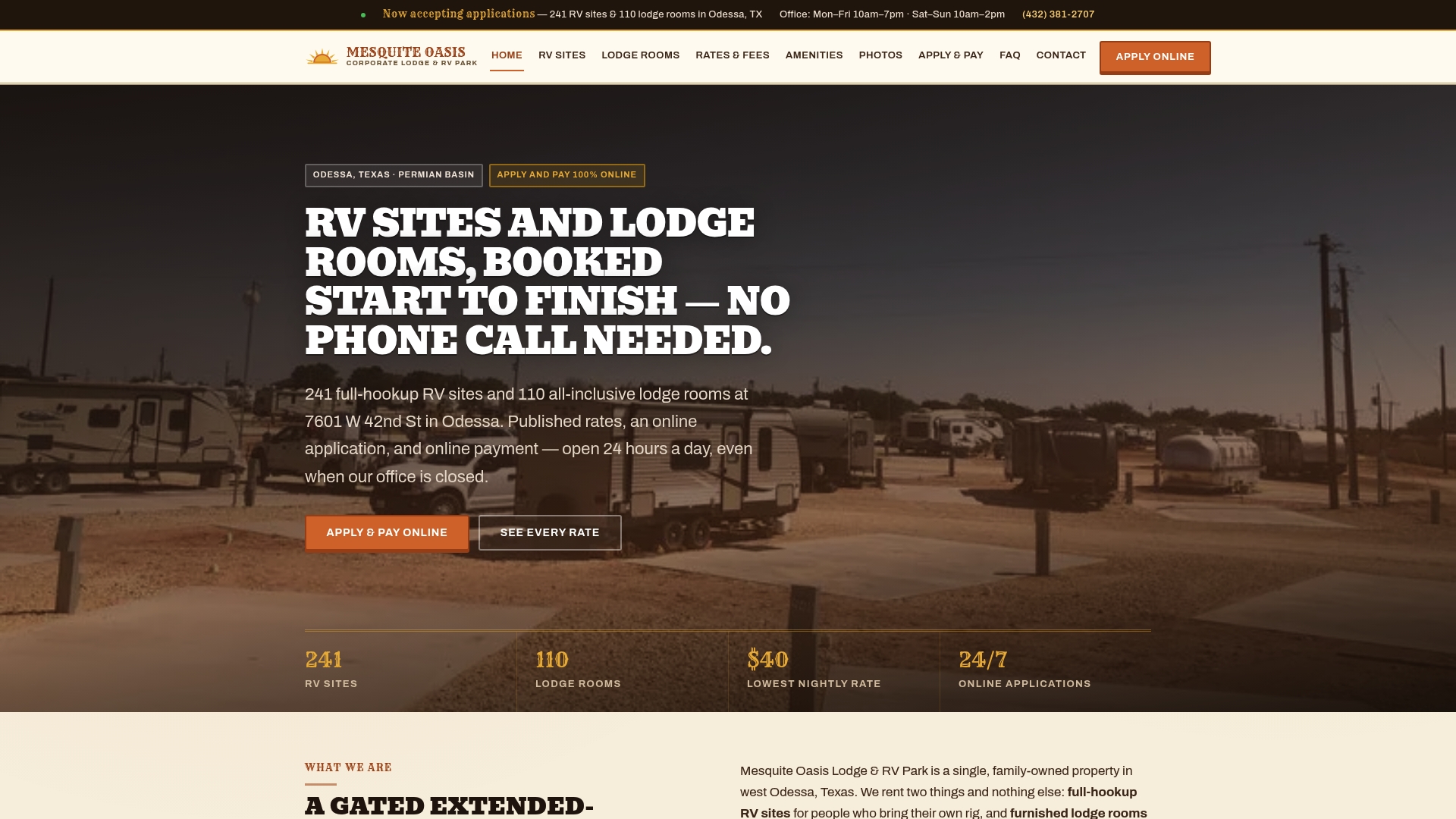
This RV resort offers many full-hookup sites with amenities suited to extended stays, including laundry, a gym, and secure access. If severe weather is forecast for your stay, check our park policies or reach out to staff directly. Ready to lock in a site before your next assignment? Browse available RV sites and apply online in minutes.
Where These Numbers Come From
The wind-speed thresholds and sensor specs above come from TJS RV's field-tested guidance, sensor trigger ranges and repair-cost estimates from RVAwningInfo, and tie-down risk warnings from the National RV Training Academy. Always consult your awning manufacturer's specifications and rely on local official weather forecasts for decisions.
Sources
- How Much Wind Can an RV Awning Withstand Before Retracting? — TJS RV
- RV Awning Wind Sensors — RVAwningInfo
- RV Awning In or Out? — National RV Training Academy