
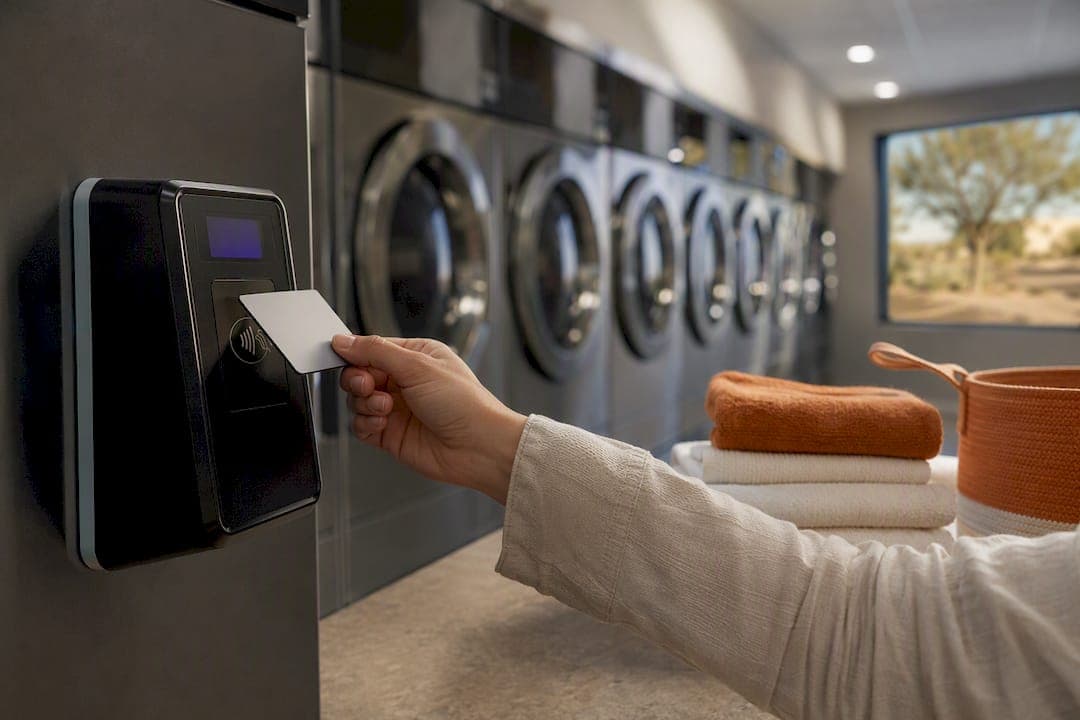
For most laundromats still running coin drops, a hybrid system is the safer first move; coinless, high-volume stores do better going card-only from day one. If you want a fast shortlist, evaluate LaundryCard for a hybrid rollout, SpyderWash for EMV-certified card-only conversion, and Laundroworks if you want mobile-first tap-to-pay. Get quotes from all three, pilot on a handful of machines, and scale from there.
TL;DR:
- Transitioning from coin drops to card-only systems accelerates efficiency but requires upfront investment in kiosks and EMV certification for security.
- Hardware costs typically range from $200 to $400 per reader, with installation labor at $50 to $100 per machine, influencing overall budget planning.
- System choice depends on existing infrastructure, with hybrid models offering easier transition, full card systems eliminating cash handling, and mobile approaches favoring smartphone users.
- Vendor verification should include checking EMV certification, offline transaction handling, and support availability to prevent costly disruptions.
- Running a pilot with 4 to 6 machines allows assessment of coin volume drop and vend success rate before full-scale implementation.
Table of Contents
- What is a laundry card system and how does it work?
- Which laundry card system fits your store best?
- How do you choose the right vendor?
- What hardware does installation actually require?
- How much does a laundry card system actually cost?
- How does a card system change daily operations?
- What security and payment details should you verify?
- What does a realistic rollout timeline look like?
- How does Mesquiteoasis apply self-service payment thinking?
- What's the smartest way to start?
- Looking for a different kind of self-service model?
- Sources
What is a laundry card system and how does it work?
A laundry card system swaps out coin drops for networked card readers wired into each machine, tied to a kiosk that reloads value onto a card, a fob, or a mobile wallet. The reader talks to a control board, the board authorizes the vend, and the transaction reports back to a cloud dashboard in real time. That's the core loop behind every product in this space, whether it's called a coinless laundry system, a card-operated laundry setup, or a laundry kiosk technology stack.
Here's how the seven main vendors stack up on what they actually do best.
- LaundryCard (Card Concepts / CCI): Card-only and hybrid deployments built around a kiosk that takes cash, debit, credit, and mobile wallets, paired with loyalty tools and time-of-day pricing. Best for stores that want coinless automation across multiple locations with centralized remote management. The standout is depth: employee tools, marketing automation, and loyalty stacked into one holistic laundry management system.
- SpyderWash (Setomatic Systems): An all-in-one payment and management platform with EMV and contactless support, plus wide compatibility across machine brands. Best for operators who need certified EMV security without ripping out existing equipment. Setomatic has been building laundry payment platforms since 1968, which shows up in how broadly its hardware fits legacy machines.
- Laundroworks: NFC tap-to-pay readers, a Value Add Center kiosk, a mobile app, offline mode, and Stripe-based processing. Best for mobile-forward stores chasing a quick tap-and-go experience. The payout and workflow detail around Stripe integration is unusually transparent for this category.
- Nayax: A global payments suite with hardware plus management software built for laundromats specifically. Best for operators who want flexible payment rails and a payments company with scale behind it. Nayax publishes some of the clearest hardware and installation cost estimates in the industry.
- Cents (TryCents): On-machine readers or kiosk options, positioned as configurable by store size through its Penny and Pulse device lineup. Best for small-to-medium stores deciding between a compact reader and a full kiosk. Costs vary by device count and installation scope.
- Octopus Laundry: A payment ecosystem built around universal brand integration and QR-based mobile pay. Best for operators retrofitting mixed-brand equipment who want app and QR flexibility without a full hardware swap.
- Tangerpay: Kiosk plus mobile app bundled together, marketed as plug-and-play with onboarding support. Best for operators who want a packaged solution and don't want to manage multiple vendor relationships for hardware and app.
Which laundry card system fits your store best?
The honest answer depends less on brand names and more on what you're already running and how much disruption you can tolerate during a changeover.
| Comparison dimension | Hybrid systems | Card-only systems | Mobile-first systems |
|---|---|---|---|
| Payment methods accepted | Coin + card + kiosk reload | Card, mobile wallet, kiosk cash-to-card | Mobile app, NFC tap, occasional kiosk |
| System type | Coin-preserving transition | Fully coinless | App-driven, minimal hardware |
| Hardware required | Reader per machine, optional kiosk | Reader per machine, kiosk required | NFC reader per machine, kiosk optional |
| Remote management & reporting | Standard dashboard | Standard dashboard, often deeper analytics | App-based dashboard, real-time diagnostics |
| Loyalty/marketing features | Reload bonuses, promos | Full loyalty suites, time-of-day pricing | App push offers, referral incentives |
| Installation complexity | Low, since coin path can stay live | Moderate, kiosk placement and wiring | Low to moderate, app onboarding needed |
| Cost shape | Reader + partial kiosk cost | Reader + kiosk + processing fees | Reader + app licensing, lighter kiosk spend |
Hybrid setups are the easiest transition because you're not asking every customer to change habits overnight. Card-only removes coin handling entirely, which cuts collection labor but demands a kiosk and full customer buy-in on day one. Mobile-first leans on smartphones your customers already carry, but it only works if your demographic actually uses an app instead of tapping a physical card.
Hardware pricing itself is a useful signal: industry quotes commonly put per-reader hardware costs around $200 to $400, with installation labor running $50 to $100 per machine. That range alone should anchor your budget conversations with any vendor pitching you a system.
How do you choose the right vendor?
Run through this checklist before you sign anything:
- Count your machines and your coin dependency. A 20-machine store still pulling steady coin revenue is a different conversation than a 60-machine store already fighting jammed coin drops.
- Decide if you need loyalty or time-of-day pricing. Not every vendor offers dynamic pricing by hour or day, and it's a real lever for filling slow afternoon slots.
- Check staffing reality. If you have no on-site attendant, remote diagnostics and offline mode matter more than they would for a staffed store.
- Confirm EMV certification in writing. Ask for documentation, not a verbal assurance, since chargeback exposure sits on you if the system isn't properly certified.
- Ask about payout timing. Some processors settle in one to two business days; others take longer, and that gap affects your cash flow planning.
- Ask what happens offline. Does the reader queue transactions and sync later, or does it just stop working during an outage?
- Ask about warranty and support hours. A system that fails at 9 p.m. on a Saturday needs a support line that answers, not a ticket queue.
- Verify compatibility with your specific machine brands. Legacy Speed Queen or Maytag boards don't always play nicely with every reader.
Red flags worth walking away from: no US-based support line, vague answers about chargeback liability, or a SaaS fee structure the sales rep can't explain in plain numbers.
Pro Tip: During any pilot, demand two numbers from the vendor: uptime percentage and vend success rate. A reader that authorizes 98% of attempted vends but goes offline twice a week is a bigger problem than one that's rock-solid but has a clunkier interface.
What hardware does installation actually require?
Every laundry card system needs a few standard components: a reader mounted on or near each machine, a kiosk or value-add center for reloading, a wireless gateway (often with cellular backup for connectivity gaps), and a cloud-based management portal tying it all together.
Most retrofits connect through a wiring harness to the machine's existing control board, using vendor-supplied brackets that mount without drilling into the cabinet. That keeps machine downtime short, often a single afternoon per unit rather than a multi-day teardown.
- Reader installation typically runs one machine at a time to avoid taking your whole store offline at once.
- Kiosk placement matters: put it somewhere visible near the entrance, not tucked in a back corner customers won't find.
- Cellular backup is worth the extra cost if your Wi-Fi has ever dropped during business hours.
- Plan installation for a slow weekday, and post signage a week ahead so regulars aren't surprised mid-wash.
How much does a laundry card system actually cost?
Budget in three buckets: hardware, installation, and ongoing fees. Per-reader hardware commonly falls in the $200 to $400 range, with installation adding $50 to $100 per machine. Kiosks run higher, often into the low thousands depending on cash-handling capability and screen size.
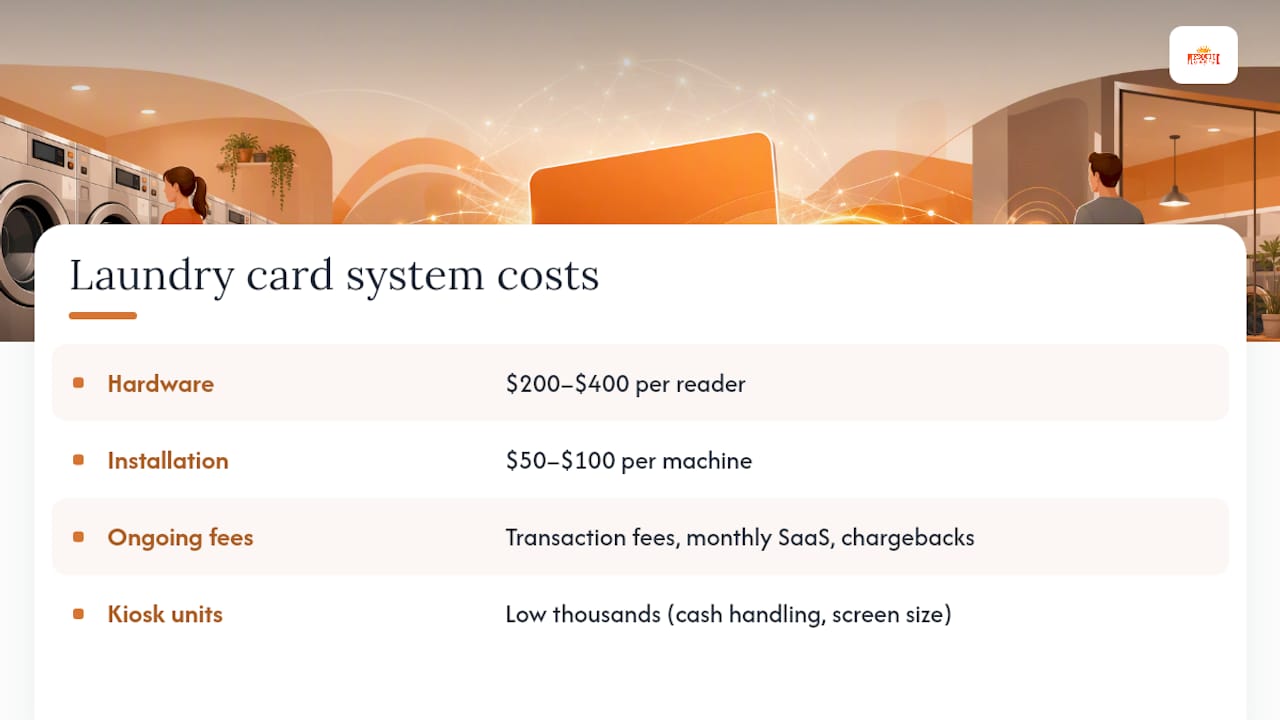
Ongoing costs include payment processing fees per transaction, a monthly SaaS or management fee, and potential chargeback exposure if EMV certification is incomplete. Cents notes that upfront totals vary heavily by device mix and installation scope, since a store choosing compact on-machine readers spends differently than one going all-in on a kiosk.
For a rough gut check: a 10-machine store might land somewhere in the low five figures once hardware, kiosk, and install labor are totaled. A 40-machine store scales that up substantially, though per-machine costs often drop slightly with volume pricing from the vendor.
How does a card system change daily operations?
Centralized collections are the biggest shift. Pulling cash from one kiosk instead of forty coin boxes cuts labor hours and removes a real security risk tied to carrying loose cash across a parking lot.
- Loyalty programs and reload bonuses give customers a reason to keep coming back instead of shopping around on price.
- Remote diagnostics flag a stalled reader or a jammed machine before a customer complains, which shortens downtime and keeps technician visits targeted instead of reactive.
- Time-of-day pricing lets you nudge volume into slow afternoon hours without manually adjusting a single machine.
Pro Tip: Set your loyalty reload bonus at a threshold that rewards a full week's worth of laundry, not a single visit. It keeps balances on the card instead of walking out the door as cash in someone's pocket.
What security and payment details should you verify?
EMV certification protects you from a meaningful chunk of chargeback liability, and it's worth requesting the actual certification documentation rather than taking a sales pitch at face value.
- Confirm typical payout windows for card transactions versus cash-to-card kiosk reloads, since reconciliation timing differs between the two.
- Ask how refunds and disputes route through the system, particularly for a machine that fails mid-cycle after a customer has already paid.
- Verify whether offline transactions queue locally and sync once connectivity returns, which prevents lost revenue during an outage.
- Get written confirmation on data security standards for stored card information, especially if the kiosk accepts contactless or mobile wallet taps.
What does a realistic rollout timeline look like?
- Week 1: Select four to six machines for a pilot, place the kiosk, and post clear signage explaining the new payment option to regulars.
- Week 4: Review early data: coin volume drop, vend success rate, and how many customers actually loaded a card versus sticking with coins.
- Day 90: Decide whether to scale store-wide based on uptime, loyalty adoption, and whether remote reporting is catching issues before customers do.
How does Mesquiteoasis apply self-service payment thinking?
Mesquite Oasis Lodge & RV Park runs its own version of this logic at scale: guests manage bookings, payments, and amenity access entirely online, unlocking laundry, gym, and recreation areas with a personal PIN rather than a front-desk key. The same principle that makes a laundry card system work, centralized control and remote account management, is what makes applying and paying online work for extended-stay guests in Odessa.
What's the smartest way to start?
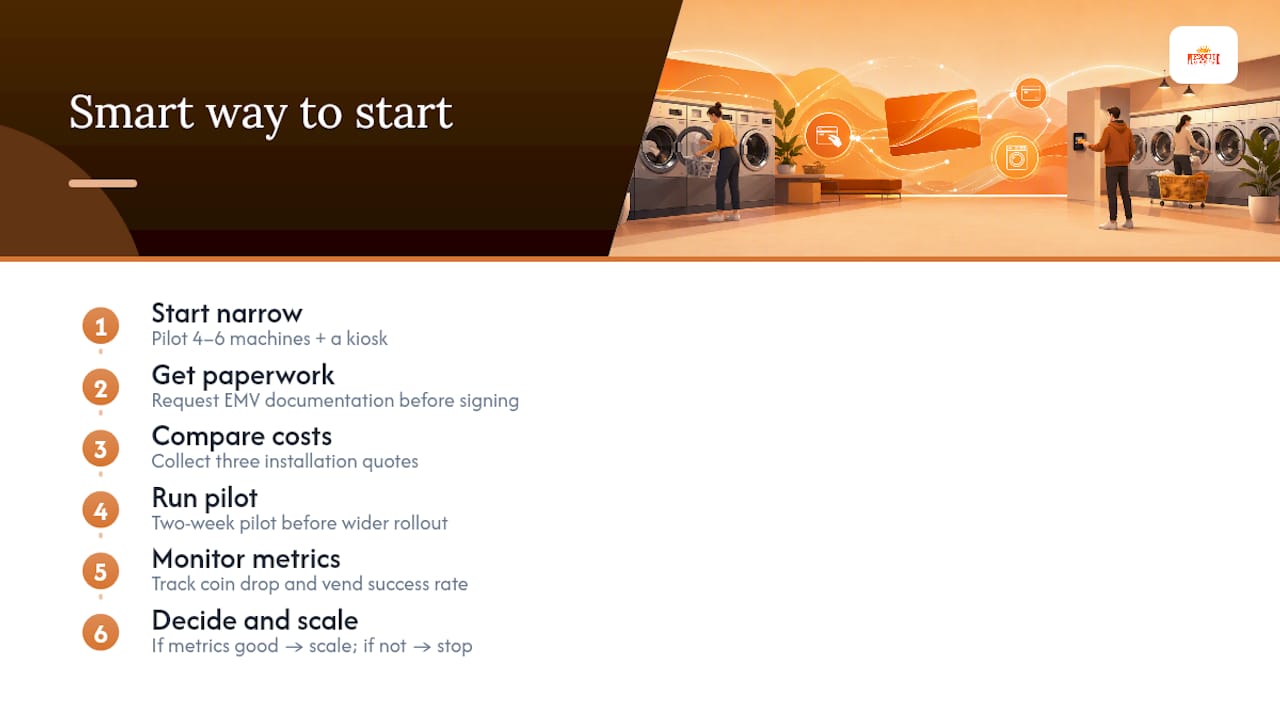
If you're still deciding, start narrow: pilot hybrid readers on four to six machines plus a kiosk, and resist the urge to convert your whole store on day one. Request EMV documentation before signing anything, collect three installation quotes so you have real numbers to compare, and run a two-week pilot before committing further.
Watch two numbers during that pilot: how much coin volume actually drops, and whether vend success rate stays above what you were getting with coin mechs. If both trend well after two weeks, scale to the rest of the store. If uptime is shaky or support is slow to respond, you just saved yourself from a store-wide mistake for the cost of six readers.
— Karen
Looking for a different kind of self-service model?
The vendors above solve payment friction inside a laundromat. Mesquite Oasis solves a related problem for a different crowd: workers on long assignments in the Permian Basin who need housing where every part of the stay, from applying to paying rent to unlocking the on-site laundry room, works on a phone with no front-desk line and no phone tag.
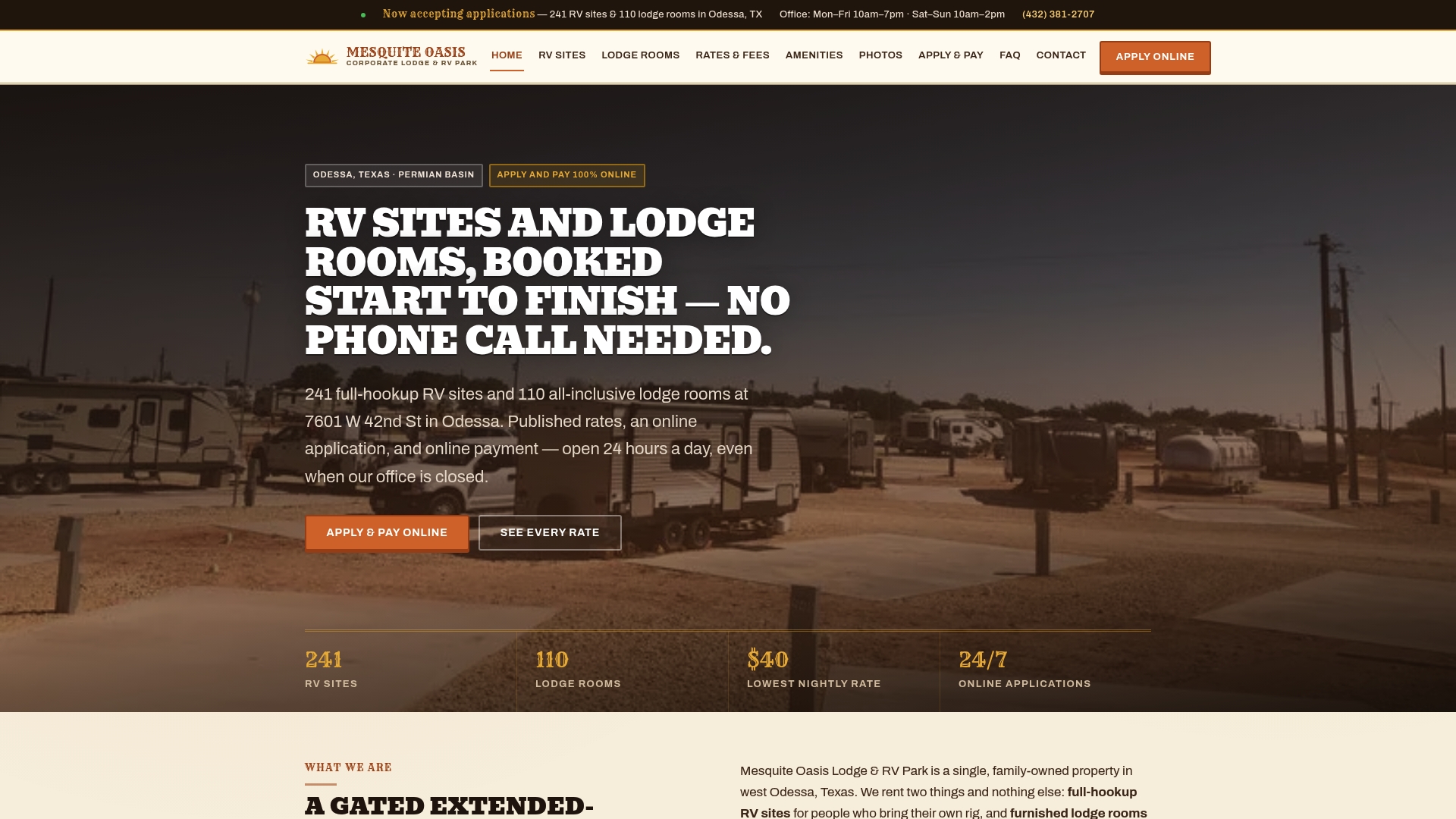
Mesquite Oasis offers 241 full-hookup RV sites and 110 furnished lodge rooms in Odessa, Texas, each accessible through a personal PIN system that covers laundry, the gym, and recreational areas the same way a card reader unlocks a washer. Companies housing whole crews get consolidated monthly invoicing instead of chasing down individual payments, and every guest can apply, get approved, and pay entirely online, 24/7, without ever picking up a phone. If your crew needs a place that runs on the same self-service logic you're evaluating for your laundromat, check current RV site availability or review furnished lodge rooms to see what fits your team's assignment length.