
Pick an inverter generator if you need quiet, clean power for electronics, camping, or an RV. Pick a conventional generator if you need maximum wattage at the lowest upfront cost, like on a jobsite or for whole-house backup. The gap between them comes down to three things: power quality, noise, and how much capacity you actually need. The sections below break down the trade-offs and help you size the right unit.
TL;DR:
- Inverter generators produce cleaner power with under 3% THD, making them safe for sensitive electronics like laptops and medical devices.
- They are quieter, often below 70 decibels at partial load, and more fuel-efficient due to engine throttling compared to constant-speed conventional units.
- Inverters tend to weigh less, usually around 45 to 55 pounds, and have a higher upfront cost due to their electronic conversion technology.
- Conventional generators are better suited for high wattage needs, such as construction tools or whole-house backup, often costing less initially but being louder and less efficient at partial loads.
- Proper sizing and safety practices, including load calculation and proper placement to prevent carbon monoxide poisoning, are essential when choosing between generator types.
Table of Contents
- Inverter Generator vs Conventional Generator: The Quick Comparison
- How Do Inverter and Conventional Generators Actually Work?
- THD, Noise, Fuel, and Weight: What the Numbers Actually Show
- Which Generator Fits Your Actual Situation?
- What Do Inverter and Conventional Generators Cost Over Time?
- How to Size a Generator for Your Actual Load
- Generator Safety: Carbon Monoxide, Placement, and Power Protection
- What to Check Before You Buy a Generator
- Why Generator Choice Shapes the RV Camping Experience
- Skip the Generator Altogether With Full Hookups in Odessa
- Sources
Inverter Generator vs Conventional Generator: The Quick Comparison
Here's the fast version, for anyone who just wants the numbers before committing to a purchase.
- Power quality (THD): Inverters typically stay under 3% total harmonic distortion. Conventional units commonly run 10% to 25% THD, which can stress sensitive electronics.
- Noise: Inverter models often idle down and run below 70 decibels at partial load. Conventional generators hold a constant, louder pitch because the engine never slows down.
- Fuel efficiency: Inverters sip fuel at low loads since the engine throttles to match demand. Conventional generators burn roughly the same amount whether you're running a phone charger or a table saw.
- Size and weight: Inverter units run lighter, often in the 45 to 55 pound range for portable models. Conventional generators of similar output tend to weigh more due to bulkier alternators.
- Price: Conventional generators generally have a lower upfront cost for similar rated wattage.
Best for: Inverters suit RVs, camping, and homes full of electronics. Conventional units suit construction sites, farms, and anyone chasing the cheapest watts per dollar.
Inverter generators typically produce THD under 3%, while conventional models commonly measure 10% to 25%, a gap wide enough to matter for laptops, medical devices, and modern appliance electronics.
How Do Inverter and Conventional Generators Actually Work?
The difference starts inside the engine, not in the marketing copy. A conventional generator spins its engine at a fixed speed, almost always 3,600 RPM, because that speed is what produces standard 60 Hz household power straight off the alternator. It runs that fast whether you're powering a single light bulb or a full load, which is why fuel use barely drops even when demand does.
An inverter generator takes a different route. It generates raw AC power, converts it to DC, then uses electronic circuitry to invert it back into clean, stable AC. Honda's technical explanation describes this conversion process as the reason inverter output stays steady even as the engine speed changes. Because the electronics handle the final waveform, the engine itself doesn't need to hold a constant RPM. It throttles up under heavy load and idles down when demand drops, similar to how a hybrid car's engine behaves.
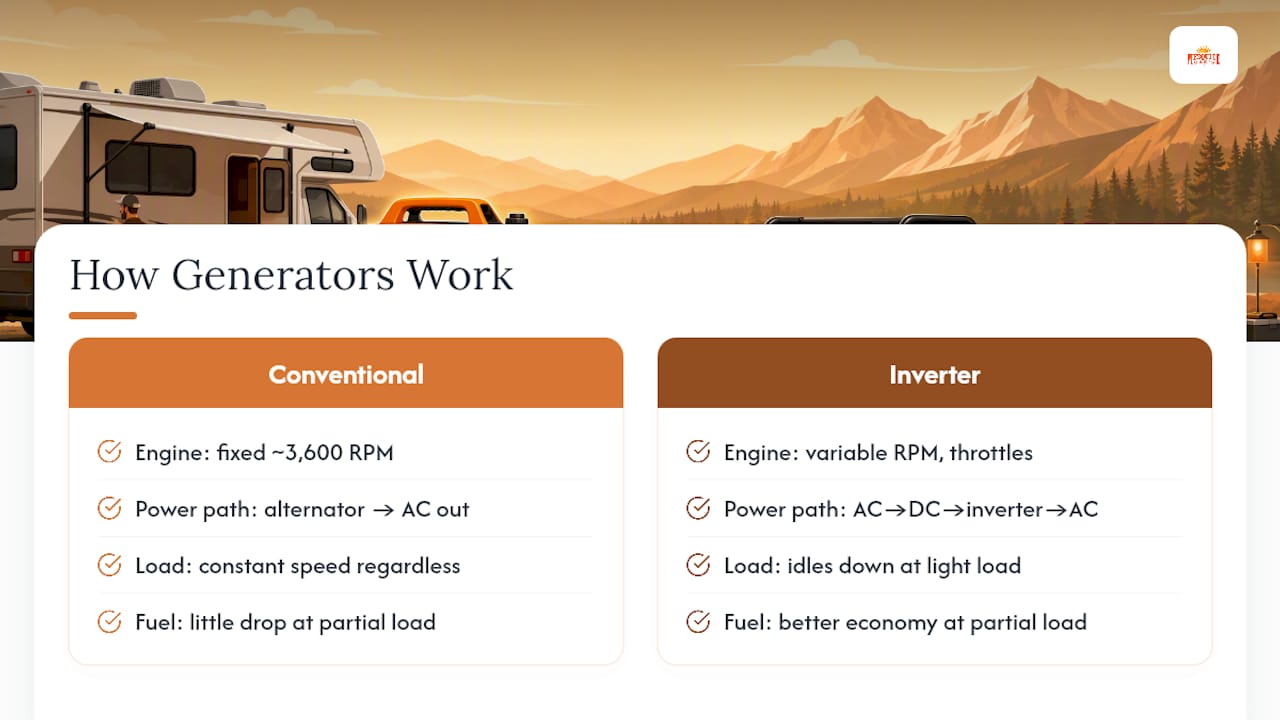
That single engineering choice cascades into everything else. Variable RPM means less noise at partial load. Less constant strain means better fuel economy when you're not maxing out the unit. And because the inverter electronics smooth the waveform before it reaches your outlet, THD drops dramatically compared to a raw alternator feed.
THD, Noise, Fuel, and Weight: What the Numbers Actually Show
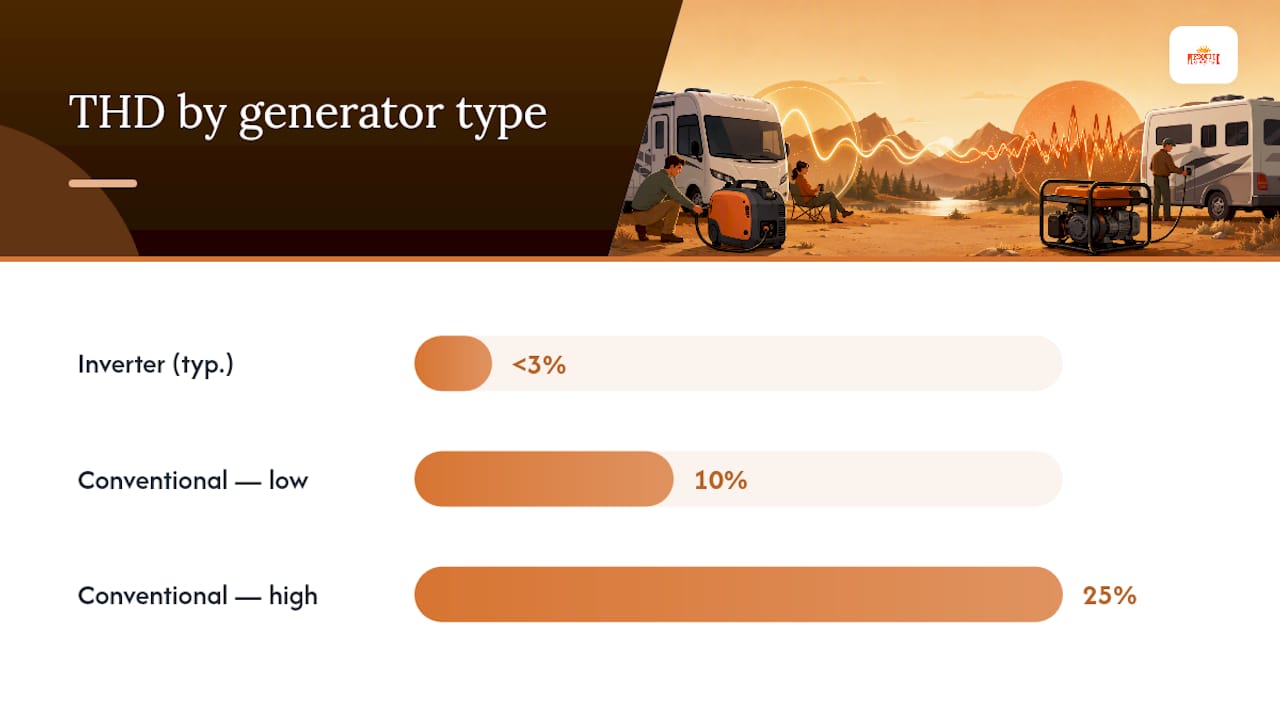
Total harmonic distortion measures how far a generator's output wave strays from a clean sine wave. Inverter models typically deliver THD under 3%, which is close to grid quality and safe for laptops, CPAP machines, and other sensitive electronics. Conventional generators often land between 10% and 25% THD. That distortion can cause flickering screens, overheating in sensitive components, or outright equipment damage over time.
Noise tells a similar story. Because inverter engines throttle down at partial load, they often run below 70 decibels, comparable to a normal conversation or a running dishwasher. A conventional generator holds its RPM steady regardless of load, so it stays loud the entire time it's running, often loud enough to require hearing protection during extended jobsite use.
- Fuel efficiency favors inverters at partial load, where the engine simply isn't working as hard.
- Field-tested examples show a Honda EU2200i running 8 to 9 hours on less than a gallon of fuel at around 25% load, a stretch conventional units rarely match.
- At full rated capacity, that efficiency gap narrows since both engines are working near their limit.
- Weight favors inverters too. Consumer models often weigh around 47 pounds, making one easy to carry with a single hand.
Consumer Reports testing backs up the pattern: inverters test quieter, more fuel-efficient, and cleaner on power quality, but conventional units remain the tool for raw output and lower sticker price. Emissions run lower on inverters too, partly because the engine spends less time working at full throttle.
Which Generator Fits Your Actual Situation?
Matching the generator to the job matters more than chasing spec sheets. Here's how the common scenarios usually shake out:
- Camping and RV trips: Inverter generators win almost every time. Quiet operation, light weight, and clean power for phones, laptops, and RV electronics make them the practical choice.
- Home backup for a few essentials: An inverter handles a fridge, some lights, and a phone charger without waking the neighborhood.
- Whole-house backup or central AC: Conventional generators, often paired with a transfer switch, deliver the wattage a single inverter unit can't touch.
- Construction and jobsite power: Conventional units still dominate here because tools don't care about THD and budgets favor lower cost per watt.
- Scaling up clean power: Two inverter generators can often run in parallel, combining output while keeping the low noise and clean waveform. It's a workaround for people who want inverter quality but need more watts than one unit provides.
The ceiling is the real limit. Consumer inverter generators typically top out in the mid thousands of watts per unit, while conventional generators scale well past 5,000 watts in a single frame. If you're running central air or heavy shop equipment, conventional generators, or paralleled inverters, are the only realistic paths.
What Do Inverter and Conventional Generators Cost Over Time?
Sticker price tells only part of the story. A small conventional generator in the 2,000 to 3,000 watt range often costs noticeably less than an inverter model with comparable output. That inverter premium reflects the electronics inside doing the extra conversion work, not just a brand markup.
Maintenance is where the story shifts. Consumer Reports notes that inverter generators are harder for the average owner to service because of their electronic components, meaning more trips to a certified technician for repairs. Conventional generators use simpler, more mechanical designs that a lot of owners can work on themselves, from swapping spark plugs to cleaning carburetors.
The math tends to favor inverters if you run the generator often at partial load, since fuel savings and quieter operation add up over dozens of camping trips or regular backup use. If you need a generator mainly for occasional full-load jobsite work, the lower conventional price point and simpler repairs usually win on total cost. The break-even point depends entirely on how often you actually run the thing and at what load.
How to Size a Generator for Your Actual Load
Sizing mistakes are the most common reason people end up disappointed with a new generator. Here's the process.
- List every device you plan to run. Note its running watts (the steady draw) and starting watts (the surge when it kicks on).
- Identify high-surge items. A refrigerator might run at 150 watts but spike to 600 watts when the compressor starts. Air conditioners behave the same way, often tripling their running wattage for a second or two at startup.
- Add up running watts for everything you'd use at once. This is your baseline continuous load.
- Add the single highest starting watt figure on top of that baseline, not every device's surge stacked together, since appliances rarely all start at the exact same moment.
- Build in a 20% margin above that total to avoid running the generator at its absolute ceiling.
- Decide if you need a transfer switch. Whole-house backup through your electrical panel requires a licensed electrician to install one safely, rather than running extension cords through a window.
Get this math wrong and you'll either overspend on capacity you never use or underpower the one appliance that matters most during an outage.
Generator Safety: Carbon Monoxide, Placement, and Power Protection
Generators kill people through carbon monoxide, not through electrical failure, so placement rules aren't optional.
- Run any generator at least 20 feet from doors, windows, and vents, with the exhaust pointed away from your living space.
- Install a battery-powered CO alarm inside if you're running a generator anywhere near your home or RV.
- Never plug a generator directly into your home's wiring; use a properly installed transfer switch instead.
- Avoid plugging medical equipment straight into a conventional generator without power conditioning, since high THD can interfere with sensitive devices like CPAP machines.
- Change the oil and check the air filter on schedule. Neglected engines run rougher, which drags down power quality on either type of generator.
Pro Tip: Keep a log of run hours near the unit. Most maintenance intervals are hour-based, not calendar-based, and it's easy to lose track after a few camping seasons.
What to Check Before You Buy a Generator
Shopping in person or online, run through this list before you commit:
- List your actual loads and total the running and starting watts.
- Set a firm budget, but weigh it against expected fuel and repair costs, not just sticker price.
- Check the THD or "power quality" spec. Reputable listings state it plainly.
- Compare noise ratings in decibels, not vague marketing language like "quiet operation."
- Look for runtime figures at a realistic load percentage, not just at the lowest possible draw.
- Confirm warranty length and where authorized service centers are located near you.
Red flags to walk away from:
- No published THD or voltage regulation specs at all.
- Runtime claims that only apply at unrealistically low load.
- Missing CO shutoff features on any generator marketed for indoor-adjacent or enclosed use.
If quiet, clean, portable power matters most, buy the inverter. If raw wattage and price matter most, buy conventional.
Why Generator Choice Shapes the RV Camping Experience
Noise and fuel questions aren't abstract for us. Guests running personal generators next to someone trying to sleep before a 5 a.m. shift is a real friction point at any RV park. At Mesquiteoasis, our 241 full-hookup RV sites exist partly to remove that problem entirely. Guests plug into shore power instead of running an engine all night, which means no fuel runs, no exhaust, and no decibel debates with the neighbors. For quick daytime use, like a tailgate or grill setup, a small inverter is still the better call.
— Karen
Skip the Generator Altogether With Full Hookups in Odessa
Running a generator on the road usually means fuel stops, noise complaints, and gear you have to haul, store, and maintain. One RV park in Odessa, Texas offers 30 and 50 amp full hookups at every site, so shore power replaces the generator entirely.

That means no fuel budget to track, no engine noise outside your rig, and no THD or wattage math to run before you plug in. Our furnished lodge rooms offer the same power reliability for anyone who'd rather skip the RV altogether. Booking runs entirely online, from application to payment, so you can lock in a site without a single phone call. Check current availability and reserve your RV site today.
Sources
- Inverter vs generator: Which is better for home use? | EcoFlow
- Pros and Cons of Inverter Generators | Consumer Reports
- What is an inverter generator | Honda Power Equipment