
For a few nights to about two weeks, an extended-stay hotel usually wins on cost and hassle. Around the 30-day mark, run the numbers before you sign anything, because furnished apartments often pull ahead once deposits and food costs are counted. Past three months, apartments typically deliver more space for less money per month, and for crews or shift workers, a lodge-and-RV setup can beat both.
TL;DR:
- Short-term stays under two weeks favor hotels due to their all-in pricing and included services, despite higher nightly rates.
- The true cost for a one-month stay often exceeds advertised prices by 10 to 25 percent once deposits, cleaning fees, and utility setup are included.
- Long-term rentals typically favor apartments or lodge and RV setups for crews, especially beyond three months, due to better rates and amenities.
- Booking flexibility is easier with hotels, while apartments require lease agreements, deposits, and stricter cancellation policies.
- Lodge and RV park options are most suitable for groups or crews with uncertain end dates, offering bundled utilities, quick application, and consolidated invoicing.
Table of Contents
- Hotel vs Apartment at a Glance
- What Does an All-In Cost Comparison Look Like by Timeline?
- Extended-Stay Hotel Pros and Cons vs Apartment Living
- How Do You Decide Between a Hotel and an Apartment?
- When Does an RV Park or Lodge Room Make More Sense Than Either?
- Location and Accessibility: Where Do Hotels and Apartments Actually Put You?
- Booking and Cancellation: What's Actually Different?
- Is a Hotel or an Apartment Safer?
- How Does Each Option Shape Your Day-to-Day Life?
- Are There Legal or Tax Differences Between Hotels and Apartments?
- When I'd Book a Hotel, an Apartment, or Something Built for Crews
- Sources
Hotel vs Apartment at a Glance
The core trade-off comes down to how each option prices convenience versus space. Hotels bundle nearly everything into one nightly or weekly rate; apartments unbundle almost everything, which lowers the base rate but adds line items you have to track yourself.
Here's the shape of the decision before you dig into exact numbers:
- Typical cost structure: Hotels charge one all-in rate (room plus utilities plus Wi-Fi); apartments charge base rent plus utilities, internet, and often a cleaning fee.
- What's usually included: Extended-stay hotels bundle housekeeping, furniture, utilities, and Wi-Fi. Apartments typically include none of that unless marketed as "furnished" or "corporate."
- Typical space: Hotel rooms run 300–450 square feet with a kitchenette; one-bedroom apartments often run 600–900 square feet with a full kitchen.
- Move-in paperwork: Hotels need a credit card and ID. Apartments often require a security deposit, application, credit check, and sometimes a co-signer.
- Best-fit examples: A contractor on a two-week assignment fits a hotel; a family relocating for a 90-day project fits an apartment better.
The hidden costs run in opposite directions. Hotels hide costs in resort fees, parking charges, and occupancy taxes that can add 10 to 15% to the sticker rate. Apartments hide costs in cleaning fees, application fees, renters insurance, and utility setup charges that don't show up until you're already committed. Neither price you see first is the price you'll actually pay.
What Does an All-In Cost Comparison Look Like by Timeline?
The only honest way to compare a hotel vs apartment stay is to calculate the true 30-day (or nightly, or quarterly) cost, not the advertised rate. That means: advertised rate, plus taxes and mandatory fees, plus anything excluded from the base price (parking, Wi-Fi upgrades, cleaning), plus deposits spread across the length of your stay.
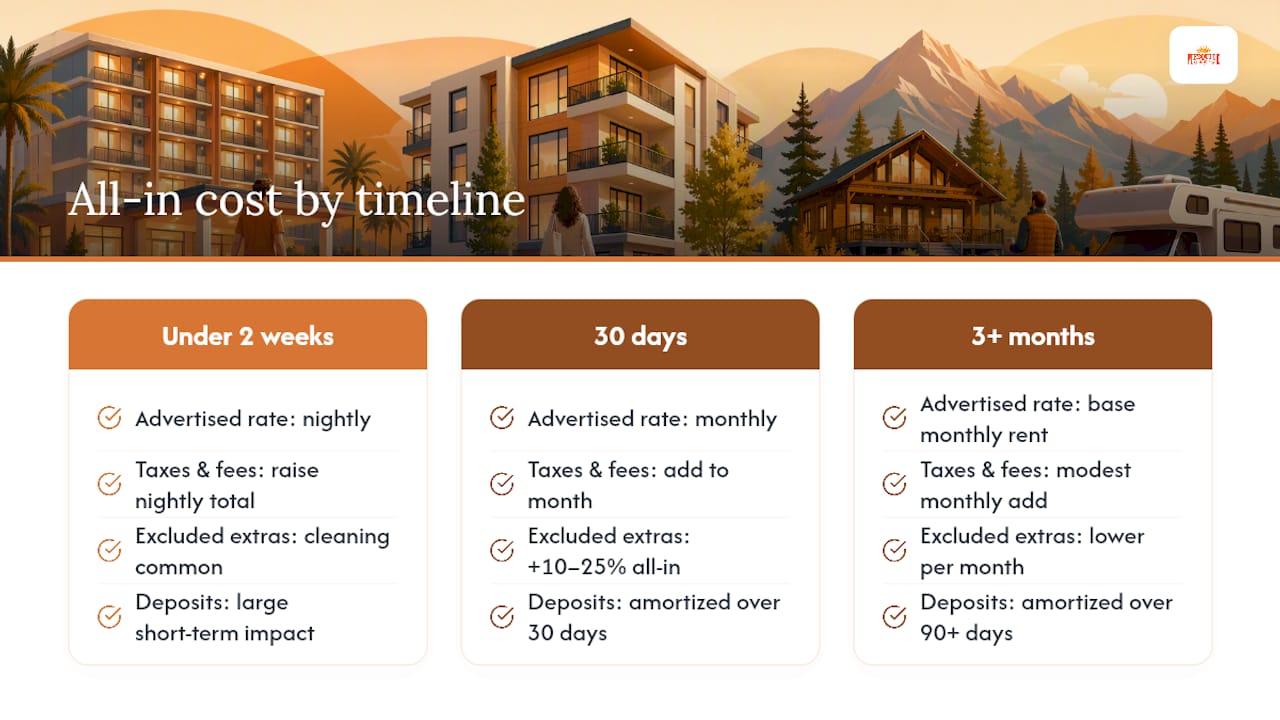
Short stays (under two weeks). Extended-stay hotels are purpose-built for this window, with aggressive weekly pricing that a landlord juggling a lease simply can't match for ten nights. Say a budget extended-stay room runs a typical nightly rate. Add occupancy tax and you land near a higher nightly total, utilities and Wi-Fi included. A furnished rental for the same window would need to cover a cleaning fee (often $100–200) and possibly a deposit that may or may not be refunded quickly, on top of a nightly-equivalent rate that's rarely built for stays this short. For under two weeks, the math almost always favors the hotel.
Medium stays (around 30 days). This is where the decision gets genuinely close, and where most people get the math wrong by comparing sticker rates instead of all-in costs. Serviced apartments often price 20 to 25% above extended-stay hotels for short bookings, but that gap narrows sharply once you're booking a full month, according to RateRanger's cost comparison. Meanwhile, the advertised monthly rate on a short-term rental typically understates the real cost, because cleaning fees, security deposits, and excluded daily expenses add roughly 10 to 25% to the true 30-day total.
Here's a concrete comparison. A midscale extended-stay hotel might run $2,400 to $3,300 a month depending on brand tier and market, all-in, according to industry rate data. A furnished apartment advertised at $2,000/month can look cheaper on paper, but add a $300 cleaning fee, a $500 deposit amortized over one month, and $150 in utility setup, and you're closer to $2,950, before groceries. The kitchen is the swing factor here: a full kitchen versus a kitchenette typically determines whether you actually save money on food, since eating out for 30 straight days adds up fast.
By the Numbers: Cleaning fees, deposits, and excluded daily expenses commonly add 10 to 25% to the advertised 30-day rental rate, while serviced apartments run 20 to 25% above comparable extended-stay hotels for short bookings before that gap narrows on longer stays.
Long stays (three months or more). Apartments usually win here, and the margin grows the longer you stay. A one-bedroom apartment at a base monthly rent with a security deposit amortized over 90 days adds a modest amount, landing near a higher total monthly cost. A comparable extended-stay hotel room, even at a discounted long-term rate, rarely drops below a similar range once you're past the initial promotional period. Ask about unpublished long-stay rates before assuming the posted price is final. Many extended-stay and serviced-apartment operators will negotiate a lower rate for direct, consecutive 30-plus-day bookings that never appears on the public rate sheet. Also worth checking: some jurisdictions refund occupancy taxes for continuous hotel stays past 90 days, which can shift the math back in the hotel's favor for very long single-site assignments.
Extended-Stay Hotel Pros and Cons vs Apartment Living
Each option solves a different problem, and the trade-offs cut through everything from your grocery bill to how much furniture you have to think about.
Hotel accommodation pros: Flexibility tops the list. Most extended-stay hotels let you cancel or shorten a stay with little penalty, since there's no lease. Bundled services (housekeeping, Wi-Fi, sometimes breakfast) save you time, and front-desk staff can solve problems a landlord's voicemail never will.
Hotel accommodation cons: Smaller footprint, limited or no full kitchen, and costs that climb fast for families needing multiple rooms. Long-term guests also report that hotel rooms start feeling cramped after the first month, especially without a real workspace.
Apartment rental benefits: More square footage, a full kitchen that turns meal costs into a grocery bill instead of a restaurant tab, in-unit laundry in many buildings, and the ability to actually personalize the space. For families or remote workers who need a dedicated desk and a door that closes, apartments usually deliver better daily quality of life.
Apartment drawbacks: Lease terms lock you in, deposits tie up cash, and furnishing an unfurnished unit adds cost and time most travelers don't have. Renters insurance is another expense hotel guests never think about, since most apartment leases expect tenants to carry it.
Pro Tip: If you're traveling with pets, check pet fees on both sides before comparing totals. Hotel pet fees are often a flat nightly add-on; apartment pet deposits can be several hundred dollars up front, sometimes non-refundable.
How Do You Decide Between a Hotel and an Apartment?
Work through these questions in order, because each one eliminates an option faster than staring at price lists.
- How certain is your timeline? If your end date could shift by weeks, book something with no lease. Fixed dates open the door to apartment savings.
- How much cash can you put down today? If a deposit plus first month's rent would strain your budget, an all-inclusive hotel or lodge rate avoids that upfront hit entirely.
- Do you need a full kitchen? If you cook regularly, weigh grocery savings against a kitchenette. If you don't cook, the kitchen advantage disappears.
- How much space do you actually need? Solo and short-term, a hotel room works fine. Families or anyone working from the room need real square footage.
- Are pets part of the picture? Compare flat nightly pet fees against apartment pet deposits before assuming either is cheaper.
- Who's booking, you or your employer? Company-booked stays for crews often do better with block-rate lodging than individual hotel or apartment bookings.
- What's the actual cancellation policy? Read it before you book, not after plans change. A "flexible" listing with a 14-day cancellation window isn't flexible at all.
Watch for red flags in any listing: vague cleaning-fee language, deposits described as "typically refunded" instead of guaranteed, or utility costs listed as "estimated" rather than fixed. If a contract can't tell you the exact all-in number, that's a sign to keep looking.
When Does an RV Park or Lodge Room Make More Sense Than Either?
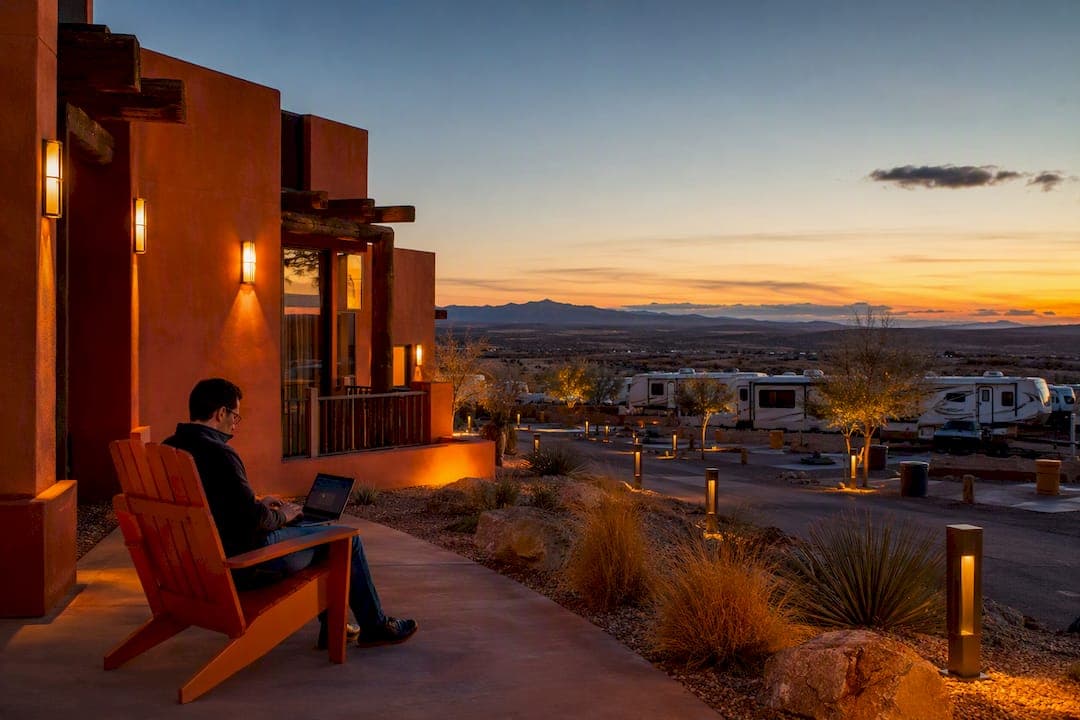
For contractors, shift workers, and crews on assignments that run weeks to many months, neither a standard hotel nor a standalone apartment lease fits well. That's the gap a facility like Mesquite Oasis Lodge & RV Park in Odessa, Texas, is built to fill.
The setup works because it borrows the best of both worlds instead of forcing a trade-off:
- 241 full-hookup RV sites for workers who already have a rig and want utilities included without hunting for a private lot.
- furnished lodge rooms with utilities and Wi-Fi bundled in. There's no separate setup process.
- Online application and payment available 24/7, meaning a crew supervisor can book housing at 11 p.m. without waiting on a phone line.
- Amenities under one PIN code, including laundry, a gym, and recreational space, all accessible without extra keys or front-desk requests.
- Consolidated monthly invoicing for companies, which turns a dozen individual hotel folios into one line item for accounting.
That last point matters more than it sounds. RV vacations and group travel can run 22 to 60% less expensive per day than comparable hotel stays for a group, and the same math applies to work crews housed for weeks at a time. A hotel bills weekly per room, multiplying overhead for every additional worker. An apartment requires a deposit and lease per unit, which is painful when a project timeline is still uncertain. A lodge and RV setup sidesteps both problems: one invoice, no per-room deposits, and furnished rooms or full-hookup RV sites ready the same day you apply.
Location and Accessibility: Where Do Hotels and Apartments Actually Put You?
Hotels cluster near highways, airports, and downtown cores, because that's where transient demand lives. That's convenient if you need to be near a job site quickly, but it often means paying city-center prices for a room you'll barely see during daylight hours.
Apartments spread across neighborhoods, which usually means more space for less money, but it can also mean a longer commute if your work site sits outside the city. For shift workers, especially those working oil-field or industrial rotations, neither option always lands near the actual job. That's part of why purpose-built lodging near work zones, like a lodge and RV park situated for Permian Basin crews, solves a problem neither hotels nor apartments were designed to solve. Parking is worth checking too: hotels near dense urban cores often charge separately for it, while apartment complexes may include one spot or none at all depending on the building.
Accessibility also differs in a less obvious way. Hotels are required to meet ADA accommodations as public lodging, with predictable ramp and room standards. Apartment accessibility varies far more by building age and management, since older rental stock isn't always retrofitted the same way.
Booking and Cancellation: What's Actually Different?
Booking a hotel takes minutes: pick dates, enter a card, done. Extended-stay hotel bookings work the same way, just with weekly or monthly rate tiers instead of nightly-only pricing. Cancellation policies are usually straightforward too, often free up to 24 to 48 hours before check-in, though longer bookings sometimes carry stricter terms once you pass the initial stay window.
Apartments involve a real process. You'll typically fill out an application, pass a credit or background check, sign a lease, and pay a deposit before you get keys, a structure rooted in standard U.S. rental-market lease norms. Canceling after signing is far harder. Breaking a lease early can cost you the remaining deposit or trigger an early-termination fee, which is exactly the kind of risk that makes apartments a poor fit when your end date isn't locked in.
Some lodging providers split the difference by offering an online application process without the traditional apartment lease burden. Applying and paying entirely online, with no phone calls required, gives crews and contractors hotel-like booking speed without sacrificing the deposit-free simplicity that makes extended stays affordable. Always read the specific cancellation and refund policy before booking, whether it's a hotel, apartment, or lodge room, since terms vary more than most people expect.
Is a Hotel or an Apartment Safer?
Hotels generally offer built-in security: staffed front desks, keycard access, security cameras in common areas, and someone on-site around the clock if something goes wrong. That matters more than people think when you're staying somewhere unfamiliar, especially solo.
Apartments vary enormously by building. A gated complex with on-site management can feel just as secure as a hotel; a standalone rental with a lockbox key exchange offers none of that oversight. Extended-stay and lodge-style facilities that use PIN-code access for amenities and gated entry combine both approaches: controlled entry like a hotel, without a front desk you have to walk past every time you do laundry at 10 p.m.

For workers on remote assignments, especially those returning from long shifts at odd hours, gated access and on-site security aren't a nice-to-have. Ask directly about entry systems, on-site staff hours, and whether common areas like laundry rooms or gyms require a code or key before booking either type of lodging.
How Does Each Option Shape Your Day-to-Day Life?
Hotels create a transactional rhythm. You interact with staff, other guests come and go constantly, and there's little sense of community because almost nobody is staying long enough to build one. That's fine for a business trip; it gets isolating past a few weeks.
Apartments and longer-term lodging setups build something closer to a neighborhood. You see the same neighbors, use the same gym or pool regularly, and start recognizing faces. For crews on multi-month assignments, that consistency matters for morale in ways a hotel simply can't replicate. A lodge or RV park designed around long-term guests, with shared amenities like a pool, basketball court, or dog park, tends to land in between: more community than a hotel, less isolation than a scattered apartment complex where everyone keeps to themselves.

Are There Legal or Tax Differences Between Hotels and Apartments?
Hotel stays are taxed as transient occupancy almost everywhere in the U.S., which is why that line item shows up on every folio. Some jurisdictions carve out exceptions for continuous stays past a set threshold, often 90 days, refunding or waiving occupancy tax once a guest crosses into effectively residential status. Check local rules directly if you're planning a stay that long, since this varies by city and state and can meaningfully change your total cost.
Apartments fall under landlord-tenant law instead of hotel-occupancy law, which means different protections and different obligations. Leases are legally binding contracts governed by state and local rental statutes, not hotel policy, so breaking one carries real financial consequences that a hotel cancellation never would. Review any lease or park terms and conditions carefully before signing, and don't assume hotel-style flexibility applies once you've committed to a fixed-term agreement.
When I'd Book a Hotel, an Apartment, or Something Built for Crews
If your dates are still moving or you're staying under two weeks, book the hotel and don't overthink it. If your timeline is locked in past 30 days and you know you'll cook, run the apartment math first, because the full kitchen and lower per-month rent usually pay for the deposit within a few weeks. If you're managing a crew or facing a work assignment with an unclear end date, a lodge or RV setup with bundled invoicing solves problems neither a hotel chain nor a private landlord is built to solve. Whatever you choose, run the all-in numbers from this guide before you sign anything. The advertised rate is never the real rate.
If you're weighing an extended stay for work in the Permian Basin, Mesquite Oasis lets you compare furnished lodge rooms and full-hookup RV sites side by side, apply online, and lock in current rates without a single phone call.
— Karen
Sources
- RVIA vacation cost comparison study
- Extended-stay hotels vs serviced apartments (RateRanger)
- Extended stay vs furnished rental cost analysis (Sonesta / AdventureBound)
- BLS spotlight: housing leases in the U.S. rental market
- Extended-stay hotel vs furnished apartment (Trifecta Corporate Housing)