
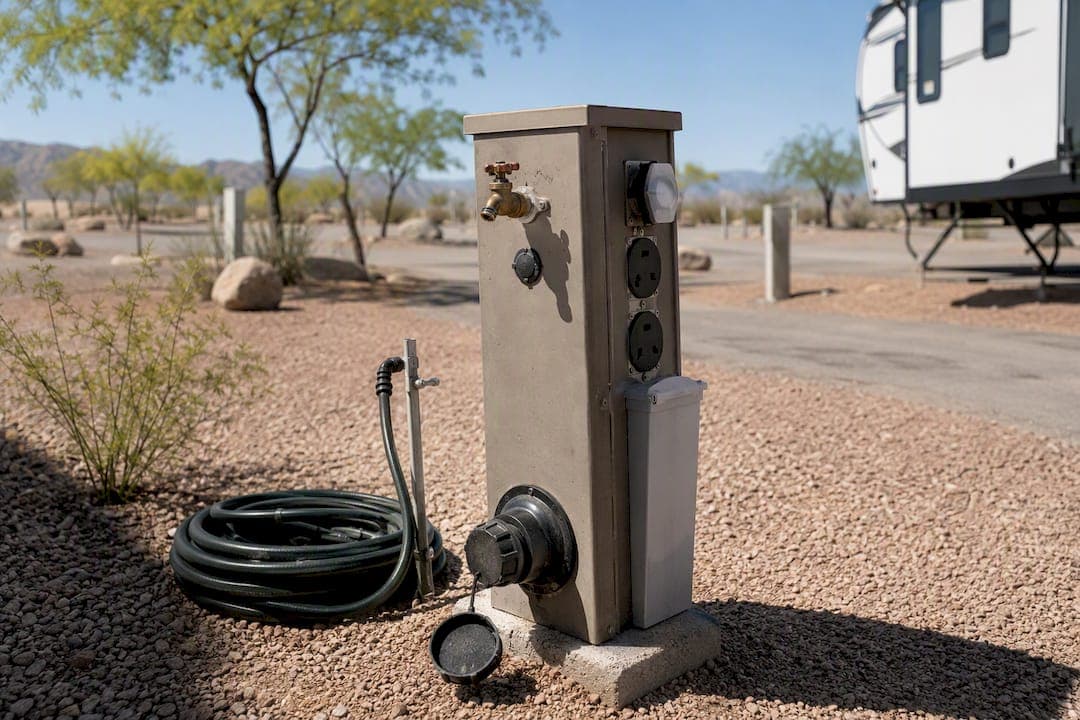
A full-hookup RV site supplies water, sewer, and electricity right at your pad, letting you run your rig like a house instead of rationing tank space. It's worth choosing over a partial or dry site whenever you're staying more than a night or two, running air conditioning for extended periods, or living on the road long-term. Just confirm the amp rating, either 30 or 50, before you book.
TL;DR:
- Confirm water, sewer, and electric connections separately, not just rely on the "full hookup" label, as it is not federally regulated.
- Check that electric service matches your rig's needs, with 30-amp suitable for lighter trailers and 50-amp for larger motorhomes, avoiding mismatched adapters.
- Use a pressure regulator set between 40 to 50 psi on park water spigots to prevent plumbing damage from high pressure spikes.
- Follow the connection order of water first, sewer second, then electricity last, and test your surge protector before powering up to avoid damage.
- Verify specific site details, including amp rating, maximum RV length, access type, and amenities through direct contact or official sources before booking.
Table of Contents
- Full vs Partial vs Dry: What the Labels Actually Mean
- Electric, Water, Sewer: The Technical Details to Check
- How to Hook Up and Use Full Hookups: Step-by-Step Checklist
- Booking Checklist: What to Verify Before You Reserve a Full-Hookup Site
- Where to Find Full-Hookup Campgrounds and How Seasonality Affects Availability
- Costs and Long-Stay Billing: What to Expect and How to Budget
- What a Professionally Run Full-Hookup Park Looks Like
- Links and Tools to Verify Hookups and Find Campgrounds
- Why the "Full Hookup" Label Deserves More Scrutiny, Not Less
- A Full-Hookup Option Built for Longer Stays, Not Just Passing Through
- Sources
Full vs Partial vs Dry: What the Labels Actually Mean
A full hookup means that your site provides the three main utilities: water, sewer, and electricity, all connected directly to your rig. A partial hookup usually gets you water and electric but skips the sewer connection, which means you're hauling gray and black water to a dump station instead of draining on demand. Dry camping, also called boondocking, gives you none of the three.
Here's the catch: "full hookup" isn't a federally regulated term. No agency defines it, so a park or booking platform can use the phrase loosely. Recreation.gov stores water, sewer, and electric as separate attributes rather than one bundled label, and that's smart, because a site tagged "standard electric" might still have full water and sewer hookups.
Before you trust a listing's headline label, check:
- Whether water, sewer, and electric are each confirmed individually, not just implied by a category name
- The amp rating listed for electric service
- Whether "full service" appears anywhere. That phrase often signals extra amenities layered on top of utilities, not the utilities themselves
Electric, Water, Sewer: The Technical Details to Check
Electric service comes in two flavors. A 30-amp connection delivers roughly 3,600 watts on a single 120-volt leg, enough for a lighter travel trailer running one air conditioner. A 50-amp hookup splits into two 120-volt legs for close to 12,000 watts, which is what larger fifth wheels and Class A motorhomes typically need. Adapters (often called "dogbones") let a 30-amp rig plug into a 50-amp pedestal, but they don't upgrade your power draw.
Water pressure is the quiet threat to your plumbing. Park spigots can run well above safe levels for RV lines.
Park water pressure can spike high enough to blow seals and split hoses inside your RV's plumbing — a regulator set around 40 to 50 psi protects against that.
Use a dedicated potable water hose, not a garden hose, and add a pressure regulator between the spigot and your intake to protect your plumbing.
For sewer, full hookups allow better tank management by emptying on your schedule rather than needing to find a dump station frequently. It's recommended to keep your black tank valve closed until it reaches a significant fill level. That buildup creates enough force to flush solids out cleanly instead of leaving a dry pyramid behind.
How to Hook Up and Use Full Hookups: Step-by-Step Checklist
Connection order matters more than most first-time RVers realize. Follow this sequence to avoid damaged fittings and flooded pads:
- Water first. Attach your pressure regulator to the spigot, then connect your potable water hose. An inline filter here catches sediment before it reaches your tank.
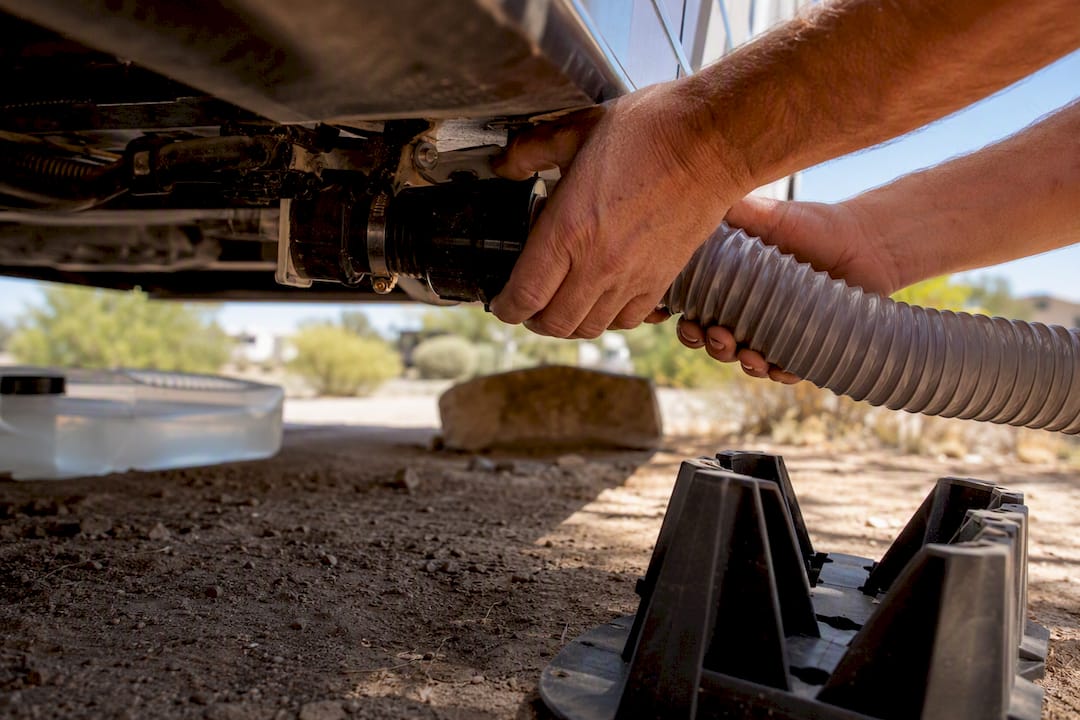
- Sewer second. Connect your sewer hose to the park's connection with a tight seal, using an elbow adapter if the pedestal sits at an odd angle.
- Electricity last. Plug in your surge protector or Electrical Management System (EMS) first, then connect your power cord to it. This order protects your appliances if the pedestal has wiring faults or voltage swings.
Pro Tip: Test your surge protector's readout before you plug in anything else. A bad ground or reversed polarity at the pedestal is common enough at older parks that catching it early can save your fridge, converter, and electronics from real damage.
Small troubleshooting habits pay off fast. If water pressure still feels aggressive even with a regulator attached, check that the regulator itself isn't faulty; they do wear out. If your sewer connection won't seat properly, don't force it. A cracked fitting is worse than a slow drip. And if a 50-amp pedestal looks incompatible with your cord, use a rated adapter rather than jury-rigging one.
Booking Checklist: What to Verify Before You Reserve a Full-Hookup Site
Reservation platforms compress a lot of nuance into a few icons, so before you commit, confirm these fields directly on the listing or with the park:
- Explicit checkboxes or notes for water, electric, and sewer, not just a general "full hookup" tag
- Amp rating (30 or 50) for the electric pedestal
- Pad surface: gravel, concrete, or dirt, which affects leveling and slide-out clearance
- Pull-through versus back-in access, especially if you're towing or driving a rig over 35 feet
- Maximum RV length allowed at that specific site, not just park-wide
Confirming hookup type, driveway type, access method, and maximum vehicle length covers the four fields that actually determine whether a site works for your rig.
Crowdsourced tools like FindFHC are useful for narrowing down options, but they run on user submissions that can go stale or get misreported. Call the park directly when a listing is ambiguous, and ask specifically whether the sewer connection is at every site or only some of them. Onsite dump availability matters too, in case you land on a partial site by mistake.
Where to Find Full-Hookup Campgrounds and How Seasonality Affects Availability
Private RV resorts are the most reliable source for full hookups, since utility infrastructure is usually part of their core pitch. Many state parks offer them too, though coverage varies. California State Parks, for example, lists many hookup sites with 30 amp and some with 50 amp service, with details published on individual park pages. Larger commercial campgrounds near interstates and job hubs round out the category.
Seasonality shifts availability hard in either direction:
- Sun Belt parks fill with snowbirds from November through March, tightening availability right when demand peaks
- National park gateway campgrounds see the opposite pattern, booking up in summer
- Parks serving industrial or shift-work areas often stay busy year-round regardless of season
The most trustworthy verification sources are official park amenity pages, state park reservation systems, and recent guest photos or reviews that show the actual pedestal and connections, not just the marketing copy.
Costs and Long-Stay Billing: What to Expect and How to Budget
Entry-level full-hookup sites at non-resort parks commonly start around $50 a night, while resort-style parks or peak-season pricing can run considerably higher. That range matters because a "full hookup" tag tells you nothing about the price tier you're actually entering.
Monthly and extended-stay rates usually work differently than nightly ones:
- Some parks fold electricity into a flat monthly rate
- Others meter usage and bill separately based on consumption
- A few charge a flat utility surcharge regardless of actual use
Before you commit to a longer stay, ask the park directly how electricity is billed and request example rates for the season you're staying. That single question prevents most billing surprises, especially in summer months when air conditioning use can spike a metered bill fast.
What a Professionally Run Full-Hookup Park Looks Like
Mesquite Oasis Lodge & RV Park in Odessa, Texas, offers a concrete example of what full-hookup infrastructure looks like when it's built for long-stay guests rather than overnight tourists. The park runs 241 full-hookup RV sites with both 30 and 50 amp service, so rigs of different sizes have the right power option without relying on adapters.
Booking and payments happen entirely online, which matters for shift workers who can't always take a call during business hours to confirm a reservation. Guests manage applications and payments any time through the park's registration portal.
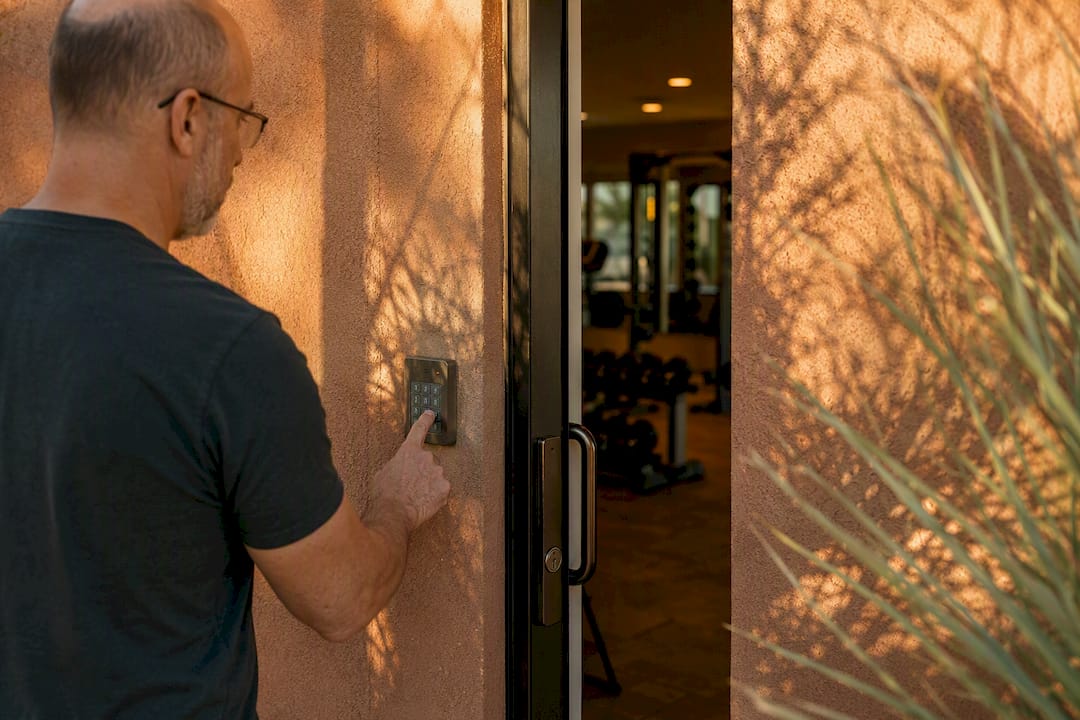
On-site amenities like laundry, a gym, and recreational areas are accessible through a personal PIN code rather than a front-desk request, which keeps access simple for people working irregular shifts. When you're evaluating any park claiming similar features, ask whether amenities require staff coordination or work independently the way a PIN system does.
Links and Tools to Verify Hookups and Find Campgrounds
For verifying hookup definitions and amenity fields, roadsurfer's guide to listing terms and California State Parks' hookup pages are solid starting points. Readers looking for a documented extended-stay full-hookup option can review site specs directly on Mesquite Oasis's RV site page or check current rates and reservation terms.
Why the "Full Hookup" Label Deserves More Scrutiny, Not Less
Most advice on this topic treats "full hookup" as a finish line: find one, book it, done. That's backwards. The label is a starting point for questions, not an answer in itself, because no governing body defines it and platforms handle the underlying attributes inconsistently.
What gets underrated is the electrical side. Water pressure and sewer etiquette get plenty of attention in RV forums, but a mismatched amp rating or a pedestal with reversed polarity can cost you an appliance or a converter board in one weekend. That's a bigger financial risk than a bad water connection, and it's the one most first-timers check last, if at all.
If I had to prioritize one habit for readers: call before you book whenever a listing feels vague, and test your surge protector the moment you plug in. Everything else, hose fit, pad surface, tank management, is manageable if those two things are solid. Extended-stay guests especially should look for parks that treat full hookups as infrastructure, not a marketing checkbox, because that's the difference between a smooth month and a string of small headaches.
— Karen
A Full-Hookup Option Built for Longer Stays, Not Just Passing Through
Most full-hookup parks are built around one or two night stays, which shows in how they handle billing, booking, and amenities. Mesquite Oasis was built the other way around, for people staying weeks or months, not passing through on a road trip.
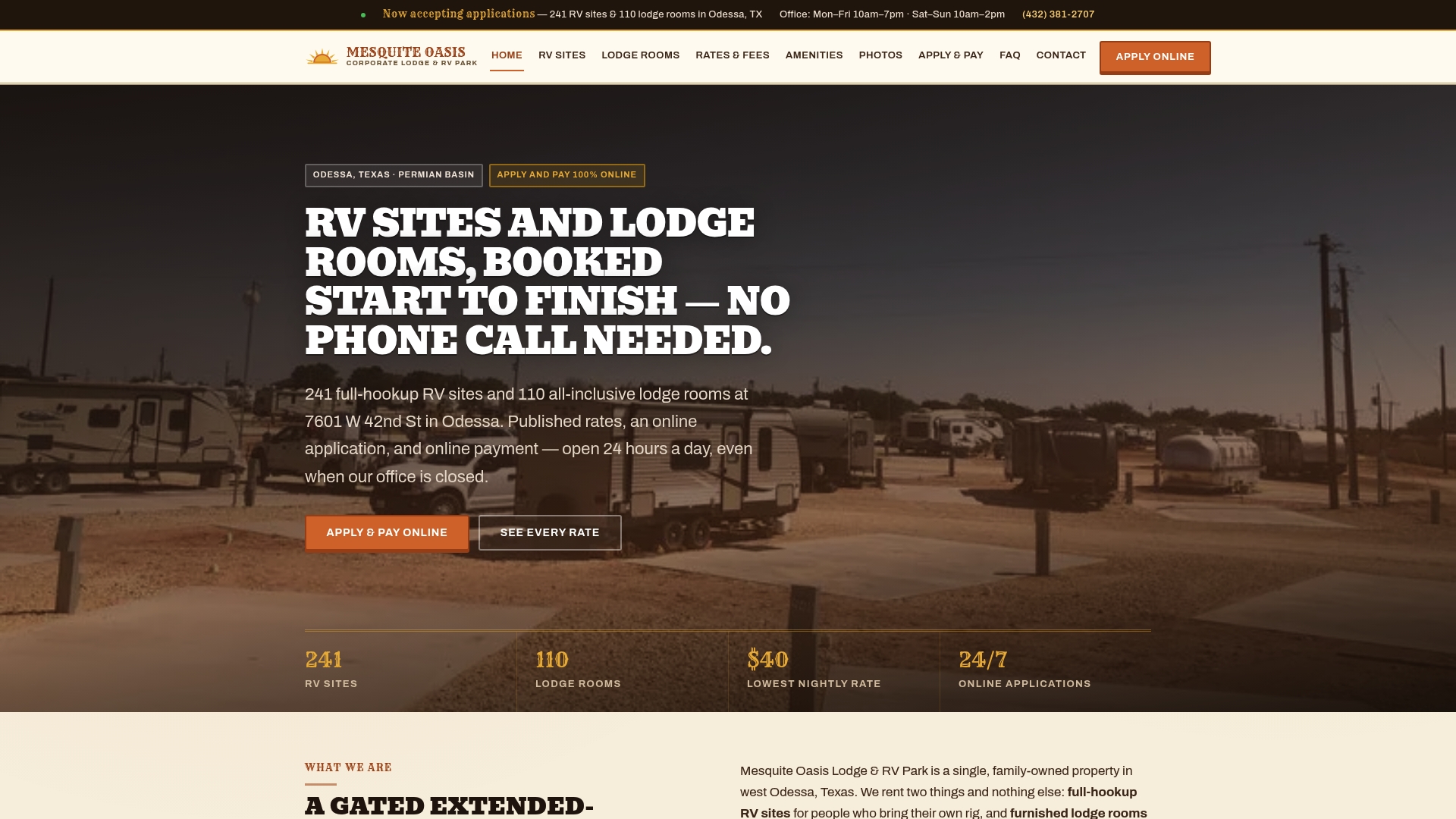
That means 241 full-hookup sites with 30 and 50 amp service already sorted by rig size, an online application and payment process you can complete at 2 AM after a shift, and amenities like the gym, laundry, and pool that unlock with your own PIN instead of a front-office schedule. Companies housing work crews get consolidated monthly invoicing instead of chasing individual receipts. If you're weighing a full-hookup site for a Permian Basin assignment or an extended stay near Odessa, check current availability and site specs on the RV sites page, then apply directly through the online registration portal when you're ready to lock in your pad.
Sources
- Camping listing terms explained | roadsurfer
- Full Hookup RV Parks: What 'Full Hookups' Really Mean (and Where to Find the Best) | RV-Parks-Guide
- RV campground costs & RV life budgeting | Sun Camper RVs
- Best RV water pressure regulators and filters | RV Upgrade Store
- Hook-up and RV Camping - California State Parks